
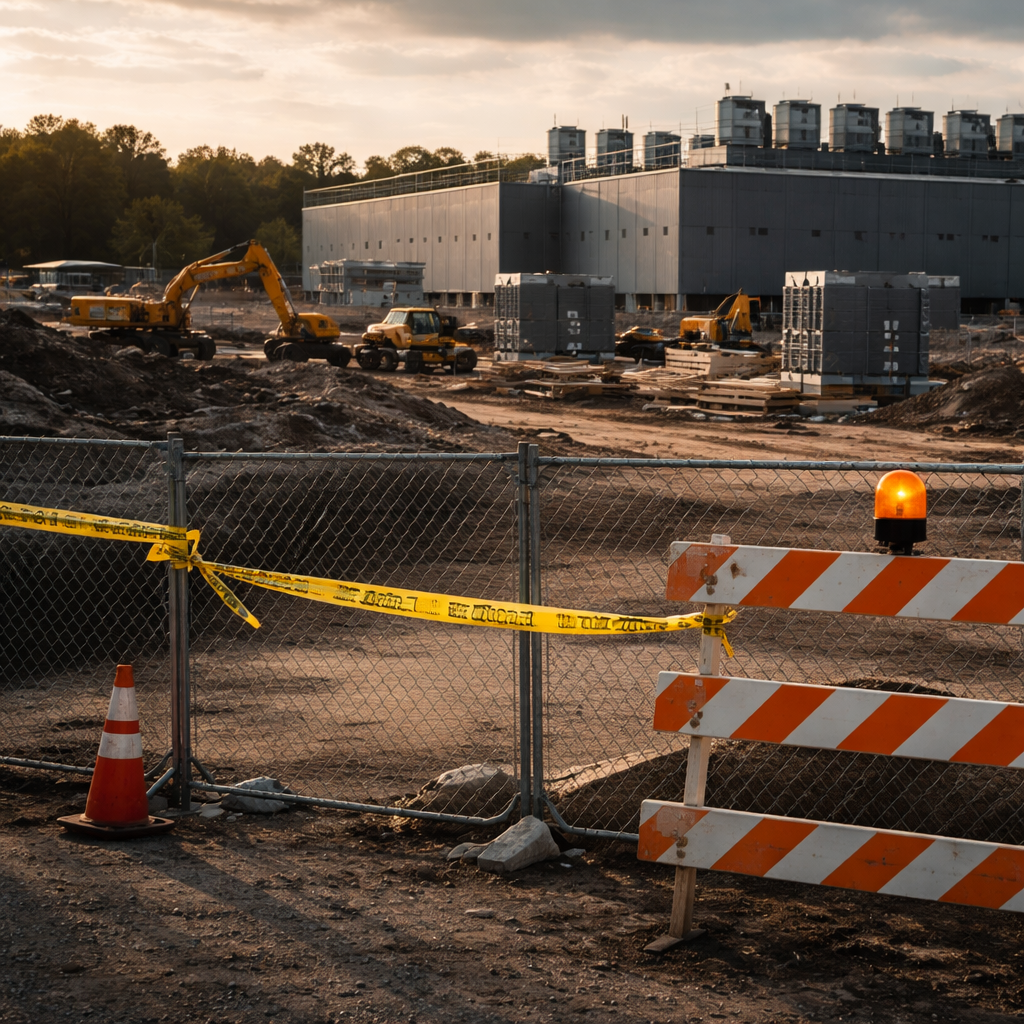
Local resistance has stalled or blocked at least 48 U.S. data center projects representing roughly $156 billion in planned investment, according to a June 5, 2026 report published by Urban Land Institute. Communities across the country are raising concerns about power demand, water use, noise, land consumption, and limited local economic benefits, transforming community pushback into what experts now call the sector's most consequential strategic risk.
The opposition has grown dramatically in scale and organization. Community resistance now includes roughly 188 local groups operating across 40 states, according to Daniel Aldrich, director of the Masters of Science Resilience Studies Program at Northeastern University. Cancellations jumped from six in 2024 to 25 in 2025, with a record pace continuing in early 2026. Bloomberg's recent reporting highlighted how local opposition has become a widespread phenomenon affecting billions in development capital. Despite continued liquidity in debt and equity markets for data center investment during a period of historic development levels, the friction between local concerns and developer plans is reshaping where and how projects move forward.
The report finds that community pushback is forcing a geographic rebalancing of the industry. Rebecca Rockey, head of quantitative insights at Cushman & Wakefield, notes that the industry is shifting "from a phase of rapid expansion to one of managed growth," with heightened scrutiny lengthening permitting timelines and raising development risk. According to Andrew Batson, global head of data center research at JLL, "community resistance has quietly become the sector's most consequential strategic risk—surpassing power availability." Thomas P. LaSalvia, head of commercial real estate economics at Moody's, characterizes the pushback as "in many ways, a necessary step toward a more efficient market outcome," arguing that rapid expansion has introduced negative externalities including energy usage, water consumption, and noise pollution that aren't fully priced into development decisions.
The practical impact is that political risk is becoming a formal underwriting variable, priced alongside power, water, and fiber access. As opposition and regulation intensify in dense, established markets, development activity is moving to unincorporated areas of secondary and tertiary markets where population density is lower and land-use conflicts are less acute. This is reshaping land values across industrial and infrastructure-oriented real estate, with sites offering both power access and political feasibility being bid up while regulatory risk becomes central to desirability. Politically receptive jurisdictions now command a premium, while markets perceived as unwelcoming face capital redirection. The pattern mirrors how controversial facility siting typically unfolds: developers don't stop building when facing organized resistance, they relocate. Capital increasingly chases the path of least political resistance—remote, sparsely populated counties, brownfield sites, and towns that have hosted industrial facilities before. Communities with high voter turnout, homeownership, and dense neighborhood networks signal a population that will fight, leading to steep discounts or outright project withdrawals.
The long-term investment thesis for data centers remains intact, but experts agree the path to deployment is getting longer and more expensive. The industry is working to re-establish its social license through ratepayer protections, local hiring pledges, and water stewardship commitments, though this effort is still a work in progress. Over time, this dynamic is likely to produce steadier but more uneven growth, with investment spreading across a wider set of markets and outcomes increasingly shaped by community acceptance as much as by supply and demand fundamentals. The irony, according to Aldrich, is that communities best equipped to extract real concessions—infrastructure upgrades, jobs, and favorable deals—are precisely the ones developers will skip, meaning projects keep landing where residents have the least leverage to bargain.