
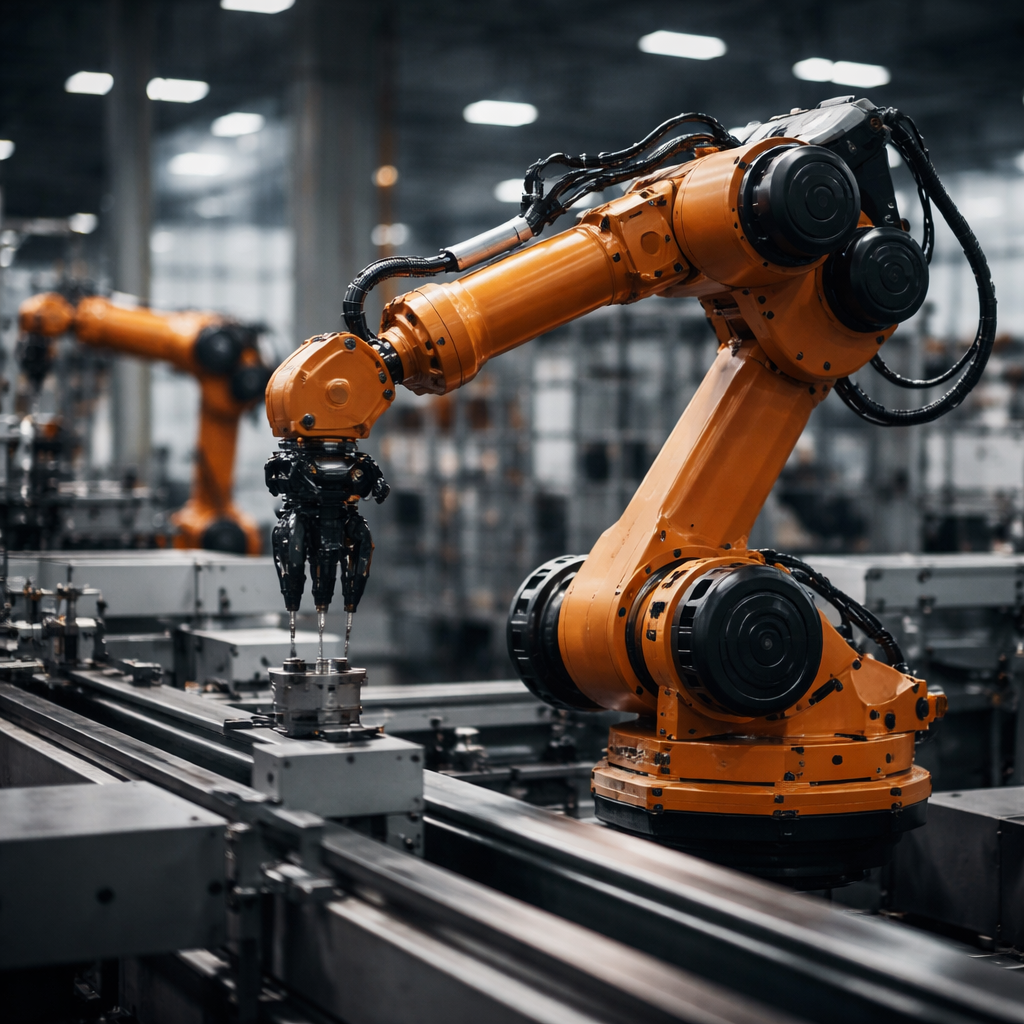
Despite inventing the industrial robot—which first went to work on a General Motors assembly line in 1961—the United States now accounts for just 5.4 percent of global robot exports, operates less than 10 percent of the world's industrial robots, and doesn't possess a single domestic foundry producing them. That's the stark assessment from a report published June 18, 2026, by the Information Technology & Innovation Foundation, which argues that America needs a comprehensive national robotics strategy to compete with China's aggressive push for global dominance in the sector.
The numbers paint a picture of underperformance and rising competition. The United States adopts just 70 percent of the robots its wage levels would predict, ranking 13th in the world, and only 8.3 percent of U.S. manufacturing firms have incorporated robots into their operations at all. China, by contrast, has installed more industrial robots in its factories than the rest of the world combined in every year since 2023, accounting for 54 percent of global installations in 2024. China's operational stock of some 2 million robots is the largest of any nation by far, and adjusted for wage levels, China adopts an astounding 12.5 times more robots than expected—the highest rate in the world. Since 2017, more than 3,400 robotics start-ups have launched in China. Meanwhile, the Chinese government has allocated at least $6 billion in subsidies to robotics and established a state-backed venture fund expected to mobilize roughly 1 trillion yuan (about $138 billion) for robotics, AI, and other frontier technologies. In Dongguan's "Robot City," more than 400 robotics firms, universities, and research institutes cluster around a government-backed research campus—compared to the ARM Institute, America's flagship public-private robotics manufacturing accelerator, which operates on roughly $30 million.
The report finds that the United States "currently stands virtually alone among leading robotics nations in lacking a national robotics strategy." According to the authors, James Wang and Mary Marsh, "U.S. federal robotics policy remains fragmented across dozens of agencies, and no office in the federal government owns the issue." They note that China has begun "innovating its own software to become a system-level competitor," wielding "a potent mix of top-down strategic direction, concentrated industrial scale, and supply-chain speed that gives its firms an iteration velocity Western competitors struggle to match." The report warns it's "likely only a matter of time before Chinese robotics firms reach the leading edge, just as Chinese firms have in electric vehicles/batteries, solar panels, nuclear power, and telecommunications equipment."
Why does this matter? The report explains that robotics capabilities increasingly determine manufacturing competitiveness in virtually every sector, from automobiles to aerospace to electronics, and experts expect it to be one of the principal drivers of future productivity growth. It's also a quintessentially dual-use technology—the same advances that power factory automation underpin cutting-edge defense systems. Robotics adoption tends to track labor costs: the more expensive human labor is, the faster a robot pays for itself by taking over that labor, so the highest-wage economies have the strongest incentive to automate. Yet despite having some of the world's highest manufacturing wages, American firms are lagging far behind. The report argues that U.S.-China competition will be "less a battle over individual technologies than a clash of entire geo-economic systems, and robotics sits squarely at the center of this." The authors ask readers to imagine an America that depends on China for the robots that build its cars, stock its warehouses, and equip its military—calling that "not an acceptable future."
The report endorses the bipartisan National Commission on Robotics Act, introduced earlier in June 2026, which would establish an 18-member commission of recognized experts charged with assessing U.S. competitiveness in robotics and recommending policies to restore American leadership. The commission would examine critical questions including how to win and hold a technological edge, how to create partnerships among industry, academia, and government, and how to expand domestic robot manufacturing. It would deliver an interim report within one year and a final report within two years. The authors recommend Congress also expand the R&D tax credit, introduce a 25 percent tax credit for adoption of robotics and other automation technologies, and direct every federal agency to create a strategy for deploying robotics in service of its mission. The bottom line: policymakers should treat robotics leadership not as a niche industrial concern but as a strategic imperative, and pass the National Commission on Robotics Act with urgency.