
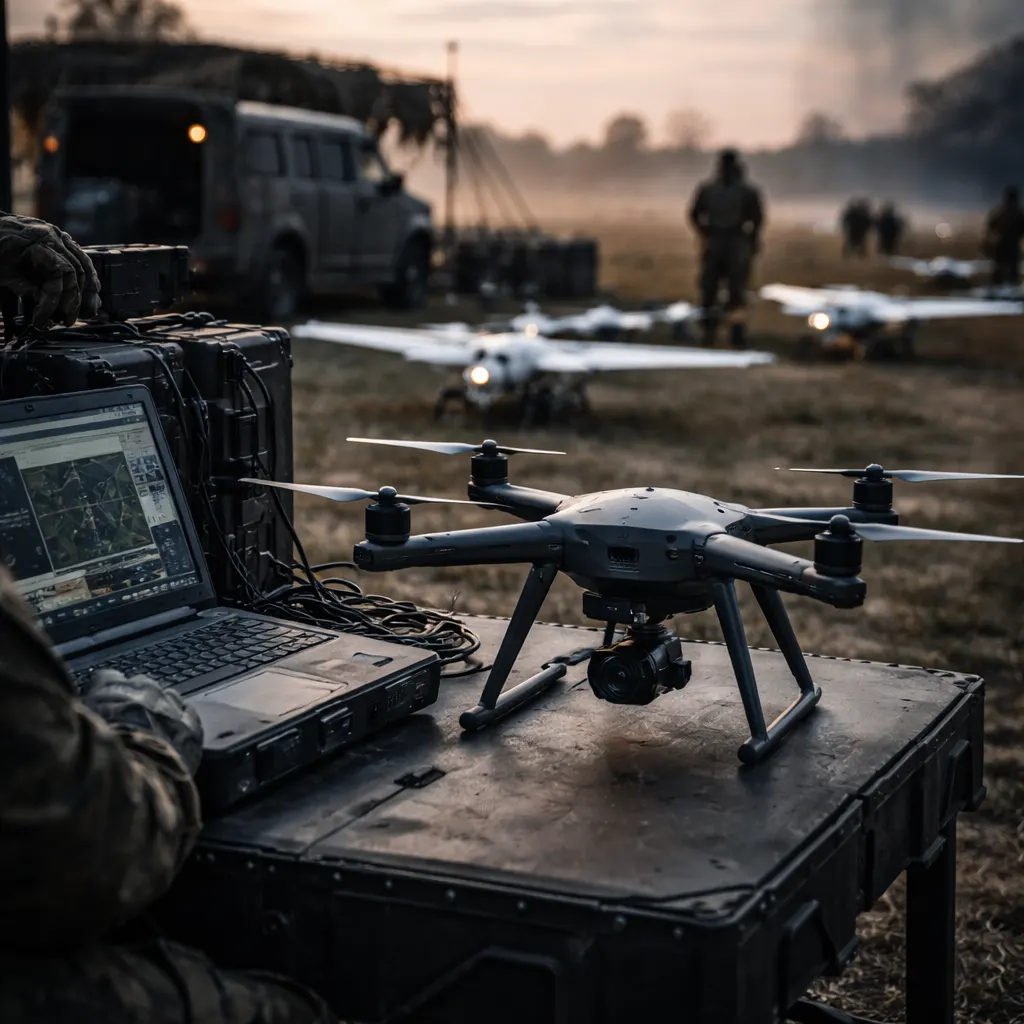
Unmanned systems now account for 70–80 percent of personnel casualties in the Russia-Ukraine War, according to a new report from the Hudson Institute examining how drone warfare has evolved into what researchers call "hyperwar"—combat conducted at machine speed with artificial intelligence compressing decision cycles beyond human rhythm. The report, published in 2026, finds that the conflict has moved from a contest of platforms to a battle dictated by algorithms, where constant surveillance and precision lethality have fundamentally altered traditional military philosophies of maneuver and attrition.
The scale of Ukraine's drone operations has reached industrial proportions. By 2024, FPV strikes and drone-dropped munitions accounted for roughly 40 percent of combat-damaged vehicles; by early 2025, that figure jumped to 60–70 percent. Ukraine fields a 20,000-strong Unmanned Systems Forces and President Volodymyr Zelenskyy announced the military will receive 50,000 unmanned ground vehicles in 2026 alone. The report documents how Ukrainian forces have created a "wall of drones" imposing an attrition belt roughly 20 miles deep along front lines, with a de facto no-man's-land extending about six miles on either side where near-constant aerial observation makes movement deadly. In one June 2026 strike on Moscow, Ukraine launched what appears to be its largest drone attack since the war began, hitting oil refineries with indigenous Fire Point drones costing up to $60,000 each—a fraction of the cost Russia spends defending against them. Meanwhile, Russia attacked Ukrainian cities in May 2026 with a record 8,000 Shahed-Geran drones and decoys, double the volume from May 2025, forcing Ukraine to expend Western air defense interceptors costing $450,000 to $3.7 million against drones that cost Russia just $20,000 to $30,000.
The Hudson Institute report finds that Ukraine's drone revolution is "built on expendable systems, modular design, rapid adaptation cycles, and high-volume production capacity," yet remains "deeply reliant on Chinese components and materials." The authors warn that China's dominance in sensors, motors, battery cells, and rare-earth elements—controlling 80–90 percent of the global drone market and about 90 percent of neodymium-iron-boron magnet production—"could expose the North Atlantic Treaty Organization to a serious wartime vulnerability." In April 2026, Ukrainian combat formations reportedly seized a Russian position using only unmanned aerial and ground vehicles, exposing not a single infantryman to combat. The report describes Ukraine's corpus of battlefield data as "an unparalleled operational dataset, primed for its Western allies' use in training artificial intelligence–driven battle networks and next-generation autonomous systems."
The report explains how this new form of warfare fundamentally breaks traditional military math. Lanchester's laws, the century-old formulas used to model combat attrition, assumed homogeneous forces with fixed effectiveness. But in Ukraine, a drone's combat value varies wildly based on operator skill, electronic-warfare pressure, software updates, and countermeasure cycles—making warfare what the report calls "a complex adaptive system" rather than a predictable equation. Ukrainian defensive positions now space fighting positions 50 meters apart with just two or three soldiers each, producing only 64–96 soldiers per mile on forward lines—a dramatic drop from the 20,000 troops per mile at Waterloo or even the 3,500 per mile in World War I. Ukraine compensates for this thinness with depth and drones, using sensors and fires to attrit enemies beyond line of sight rather than concentrating infantry. The cost-exchange ratio favors cheap, expendable platforms: a single expensive interceptor destroyed for every disposable drone sent over the border isn't sustainable defense economics. Russia has adapted too, establishing its Rubicon drone unit in August 2024, which has grown from 1,450 personnel to roughly 5,000 by spring 2026, with plans to reach 9,000—institutionalizing drone combat as a permanent feature of its military.
NATO's struggles to adapt were laid bare in recent exercises. At Hedgehog 2025 in Estonia, a Ukrainian team of about 10 soldiers using the Delta battlefield-management system notionally destroyed 17 allied armored vehicles and conducted 30 additional strikes in roughly half a day against a mechanized force of several thousand NATO troops. At the maritime exercise REPMUS/DYMS 2025 in Portugal, Ukraine led the Opposing Force for the first time in NATO history—and won all five scenarios against allied Blue teams in port defense and convoy protection drills. The report warns that "winning wars in the coming decades will require more than buying or producing drones," but instead demands "developing the battle networks, combat data processing systems, industrial capacity, electromagnetic-spectrum resilience, and adaptive institutions and doctrines needed to fight at the OODA rate that the war in Ukraine is normalizing." With Ukraine now sharing its military-grade battlefield data with strategic partners to train AI models, NATO faces a choice: master machine-speed warfare now, or face catastrophic vulnerability when cheap drones meet expensive defense systems in the next major conflict.