
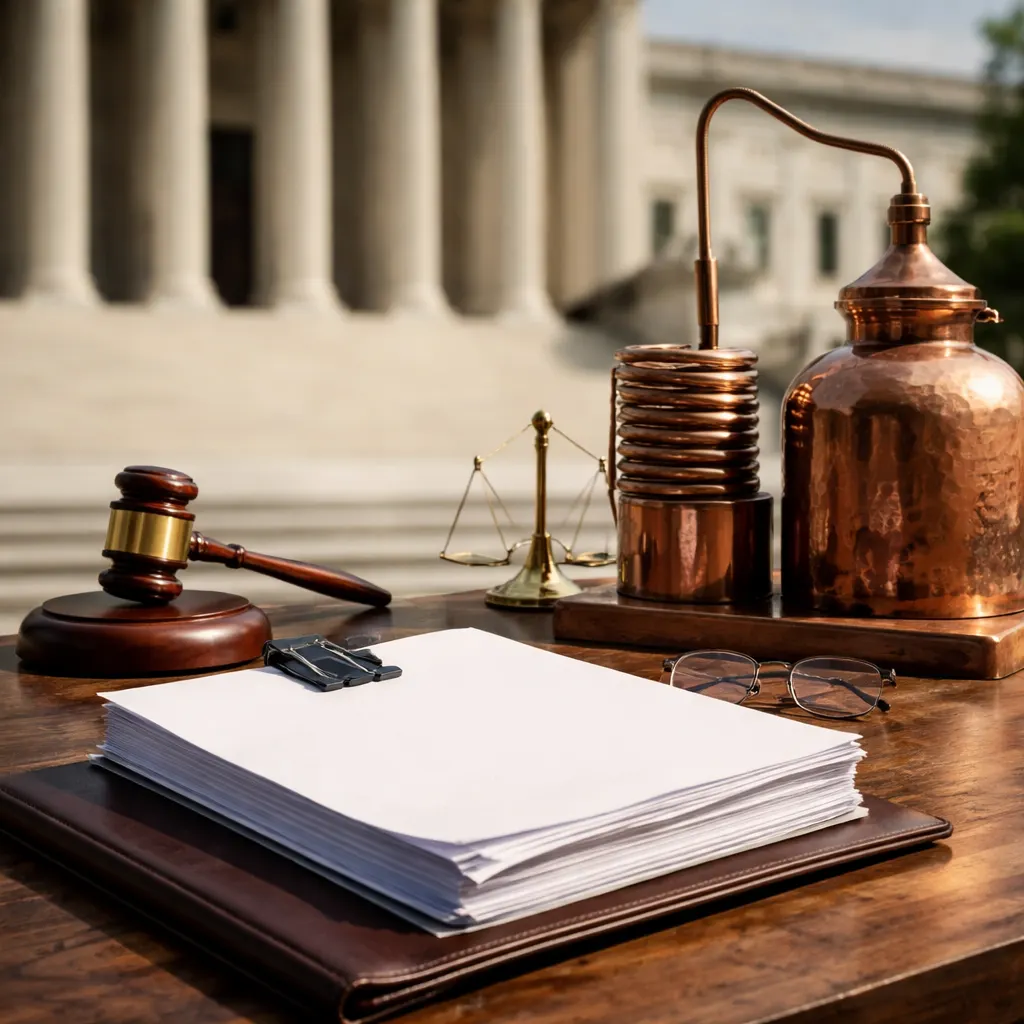
Ohio aerospace engineer and brewery owner John Ream filed a petition Monday asking the Supreme Court to hear his challenge to federal law that prohibits making distilled spirits at home. The case, detailed in an analysis by The Buckeye Institute, raises fundamental questions about the limits of federal power under the Constitution's Commerce Clause. While federal law allows home brewing and small-batch winemaking, it bans distilling or even owning a still in any dwelling house, with penalties including fines, property forfeiture, and imprisonment.
The home-distilling prohibition dates back to what the analysis describes as "a sop to the temperance movement" and survived both Prohibition and its repeal. George Washington's Mount Vernon distillery produced more than 10,000 gallons of whiskey per year by 1799, but Congress later barred distilling inside homes or any connected structures. The U.S. Court of Appeals for the Sixth Circuit upheld the ban, ruling it "is a necessary and proper means of collecting the federal excise tax on spirits" because stills could be hidden to evade taxation. However, the Fifth Circuit reached the opposite conclusion eleven days earlier, with Judge Edith Jones finding that the ban serves to "reduce revenue by preventing individuals from making distilled spirits" otherwise subject to taxation.
According to the analysis, the case takes aim at the 2005 Supreme Court decision Gonzales v. Raich, which upheld federal prohibition on home cultivation of marijuana even under state regulation. The authors write that Raich "applied its aggregation principle to noncommercial activity and adopted the maximally deferential 'rational basis' standard for assessing Congress's need to regulate non-interstate activities." Justice Thomas, the sole remaining justice from that case, dissented by arguing that if the majority were right, then "the Federal Government is no longer one of limited and enumerated powers." The split between the Fifth and Sixth Circuits on the ban's constitutionality provides reason for the Supreme Court to take the case and resolve the conflict.
The analysis explains that the case tests whether the current Supreme Court will continue expanding federal commerce power or return to stricter limits. The 1942 Wickard v. Filburn decision allowed Congress to regulate any activity that, in aggregate, has a substantial effect on interstate commerce, even permitting restrictions on an Ohio farmer growing wheat solely to feed his family and animals. The Court appeared ready to limit this power in the 1990s with decisions striking down the Gun-Free School Zones Act and a statute on gender-motivated violence, but Raich reversed that trend. The authors note that the three justices appointed by President Trump "have not been afforded the occasion to opine on the Commerce Clause's limits," but all three "take seriously the Constitution's original meaning, its structural features, and the enumeration of powers as a constraint on federal power."
The analysis concludes that resolving Ream's challenge would be "a meaningful first step toward rekindling the federalism revolution." Given what the authors describe as "the massive growth of the federal government and its intrusion into every facet of modern life, there are few issues more important or pressing for the Court's consideration." The case offers the current Court an opportunity to clarify the Commerce Clause and determine whether Congress can criminalize home conduct simply because it might conceal taxable activity.