
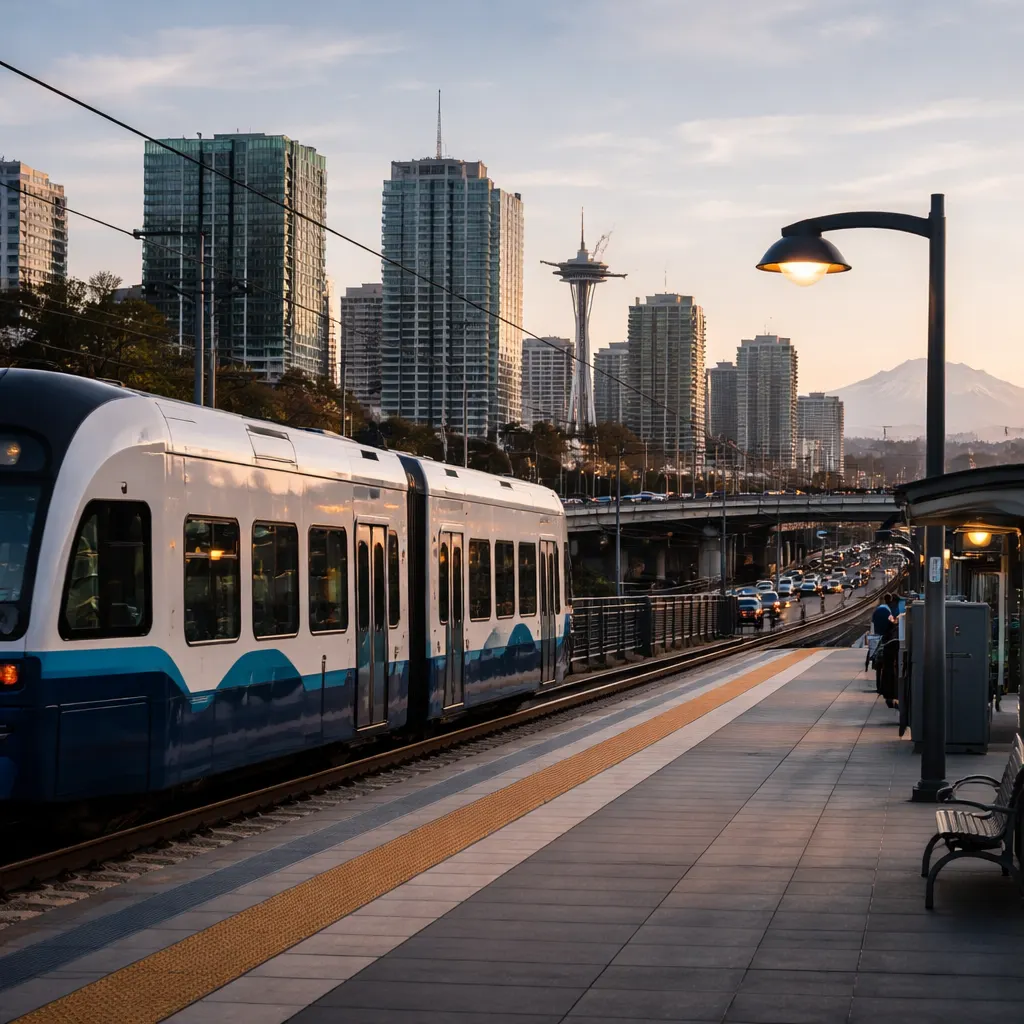
Two major Washington cities are proposing sales tax increases for transportation projects that largely ignore state guidance on how the money should be spent, according to a recent analysis from the Washington Policy Center. Seattle wants a 0.3% sales tax hike that would push the city's rate to 10.7%, the nation's highest for any major city, while Bellevue is considering a 0.1% increase paired with vehicle license fees of $20 to $40. The analysis finds both proposals fail to show how the new revenue would address traffic congestion, freight movement, or cost-effectiveness—criteria explicitly outlined in state law governing Transportation Benefit Districts.
Seattle's proposal would generate roughly $138 million annually, with most funds directed toward subsidizing additional Metro bus routes within city limits, keeping the Seattle Streetcar running, and offering free ORCA cards to low-income residents. Bellevue's plan would funnel the bulk of its revenue into "neighborhood mobility," bike and pedestrian projects, and unspecified major initiatives, with less than 8% earmarked for street preservation and under 20% for vehicle mobility. If Bellevue moves forward, its sales tax would climb to 10.5%, and the city council could enact the increase without a public vote. Seattle's measure, by contrast, will appear before voters in November.
The report notes that Seattle has given no apparent consideration to using Transportation Benefit District funds for overdue street repairs, even though the city's Department of Transportation reports 35% of Seattle's roads are in poor or very poor shape. According to the analysis, postponing maintenance work will drive up costs later when full street reconstruction becomes necessary, while motorists and cyclists face growing hazards as pavement quality worsens. State law requires districts to weigh factors including reduced facility failure risk, better travel times, cleaner air, expanded trip capacity, modal connections, freight mobility, cost-effectiveness, system performance, accessibility for people with special transportation needs, and other locally adopted benchmarks. Neither proposal demonstrates how projects would meet these standards.
The analysis argues the legislation succeeds in handing cities another funding stream but fails to ensure the money advances state transportation goals or delivers value for the price. More than 100 Transportation Benefit Districts have been established over the past two decades, typically to pay for street improvements, sidewalks, and bridge repairs. The law lets cities impose a 0.1% sales tax or license fee up to $40 per year through council action alone, with higher rates possible if voters agree. Yet the Washington Policy Center's review shows cities can sidestep the guidance meant to shape spending decisions, potentially producing high tax burdens with minimal gains in system performance.
To achieve better results, the report recommends that state lawmakers establish explicit priorities for Transportation Benefit District revenue, set cost-effectiveness thresholds for projects, and mandate that cities demonstrate how funds will improve transportation efficiency. Without those changes, residents in Seattle and Bellevue may face some of the steepest sales taxes in the country with little assurance the spending will ease commutes, fix crumbling roads, or move freight more reliably.