
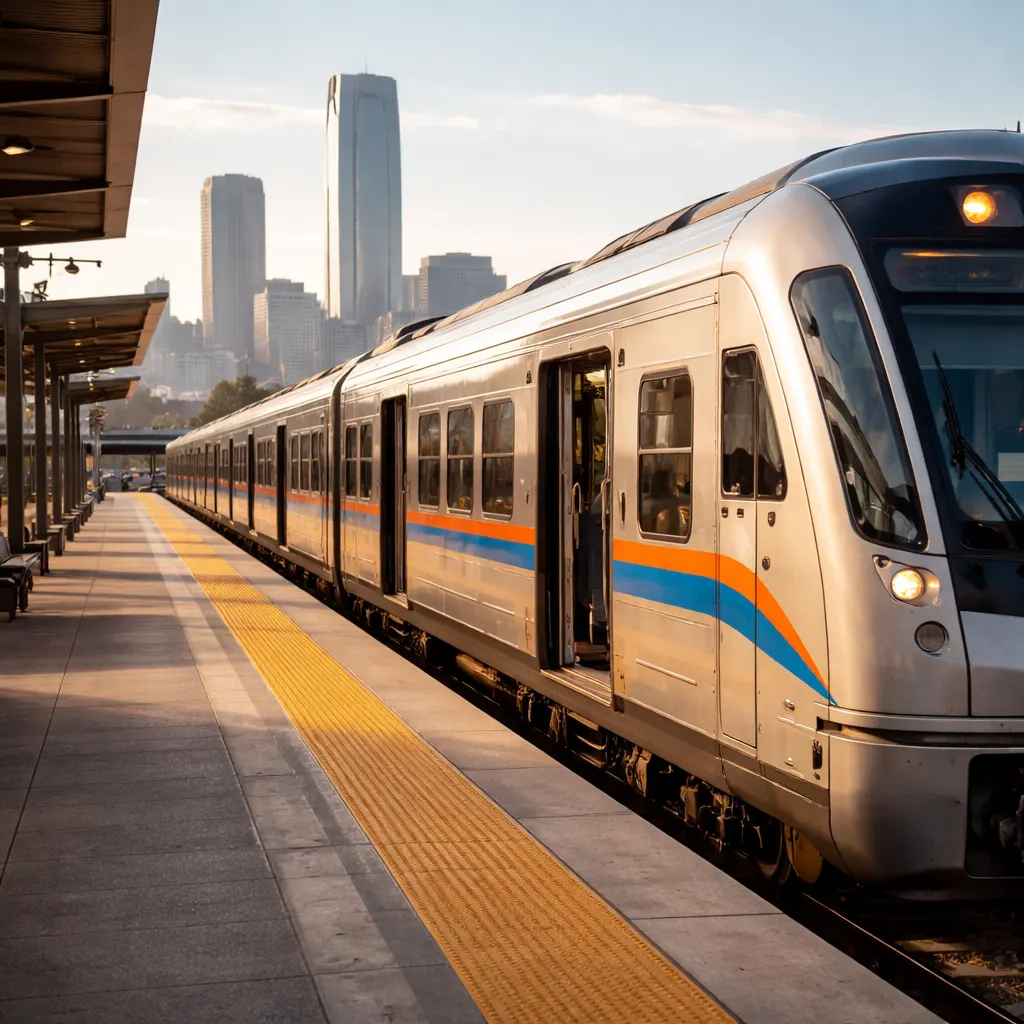
A proposed commuter rail system for the Oklahoma City metro area would take passengers longer to reach their destinations than driving the same route by car, according to an analysis published by the Oklahoma Council of Public Affairs. The $1.8 billion rail line would stretch 39 miles from Edmond through Oklahoma City to Norman, requiring partial funding through a local tax increase that metro officials are asking voters to support. Despite the investment, the analysis concludes the system won't offer speed or convenience advantages over automobile travel.
Officials estimate the proposed rail would run at an average speed between 60 and 79 miles per hour. If the train maintained 79 mph without pausing, the complete journey from Edmond to Norman would require 29.6 minutes. But with 10 scheduled stops along the route, the analysis notes each three-minute stop would add roughly 30 minutes to the trip, pushing total train travel time to nearly an hour. By comparison, driving from the University of Oklahoma in Norman to Edmond currently takes 39 to 49 minutes, while the reverse trip requires 37 to 57 minutes depending on time of day, according to online rush-hour data cited in the report. A 2020 study of four major transit systems in São Paulo, Stockholm, Sydney, and Amsterdam found that public transit journeys took on average 1.4 to 2.6 times longer than driving, with strong evidence that car-based trips are frequently faster.
Baruch Feigenbaum, senior managing director of transportation policy at Reason Foundation, told the report that "travel time for commuter rail is typically 1.5 to 2 times longer than for cars." He explained that trains make multiple passenger stops while personal vehicles don't, and most people don't live or work immediately adjacent to rail stations, requiring additional travel time to reach platforms and final destinations. Randal O'Toole, director of the Independence Institute's Transportation Policy Center, stated flatly: "There is no way that rail will be as fast as driving." O'Toole added that buses would probably be faster than the proposed rail system.
The analysis explains that the projected average speed may prove optimistic in actual operation. O'Toole notes that trains require substantial time to decelerate for stops and accelerate afterward, meaning the Oklahoma City commuter rail may rarely reach 70 mph and could average closer to 50 mph in practice. The report draws a parallel to Colorado's proposed Connector rail system between Fort Collins and Pueblo, which would take 105 minutes from Fort Collins to Denver compared to 65 minutes by car during off-peak times or 90 minutes during rush hour. These mechanical realities—the physics of slowing and speeding multi-ton rail cars—combine with the logistical challenge of reaching stations to create inherent time disadvantages for commuter rail compared to point-to-point automobile trips.
If the Oklahoma City system operates as projected and performs similarly to comparable rail networks nationwide, passengers will need to budget more time for train travel than driving the same distance would require. The analysis suggests that metro officials promoting the tax increase can cite various rationales for the $1.8 billion investment, but speed and convenience won't be among them.