
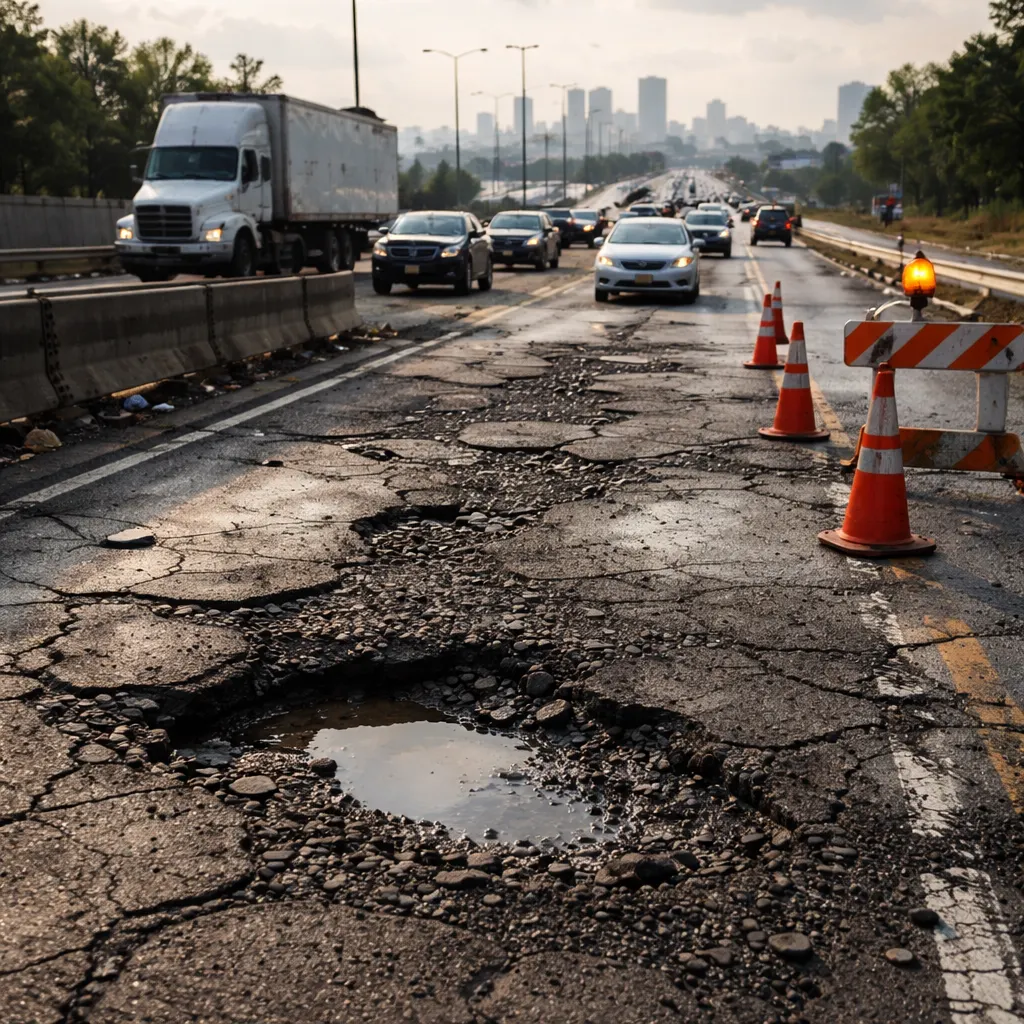
New Jersey's highway system has fallen to 40th place nationally in overall cost-effectiveness and condition, a six-spot decline from last year's 34th-place ranking, according to the 29th Annual Highway Report published by Reason Foundation. The assessment evaluated state-controlled highways across 13 categories, including pavement and bridge conditions, traffic fatalities, congestion, and spending. New Jersey's drop reflects mounting concerns about urban road quality and ballooning maintenance costs despite relatively strong safety performance.
The state's highway performance varied sharply across categories. New Jersey ranked last in the nation for traffic congestion, with drivers spending approximately 85 hours annually stuck in traffic. Urban pavement quality lagged badly, placing 42nd for urban interstate pavement condition and 41st for urban arterial pavement condition, while rural roads fared better at 17th and 31st respectively. Bridge infrastructure landed at 27th for structurally deficient bridges. The state performed strongest in safety metrics, ranking 16th in rural fatality rate, 14th in urban fatality rate, and 4th in other fatality rate. On spending, New Jersey placed 44th in capital and bridge disbursements—the costs of constructing new roads and bridges and widening existing ones—42nd in maintenance disbursements such as repaving roads and filling potholes, and 31st in administrative disbursements. The steepest decline came in maintenance spending, which plummeted from 16th to 42nd compared to the previous report.
Baruch Feigenbaum, lead author of the report and Senior Managing Director of Transportation policy at Reason Foundation, said "New Jersey should focus on reducing Urbanized Area Congestion and improving its Urban Arterial Pavement condition while reducing its roadway spending." The report notes that while the state performs well in fatality rates, its rankings in congestion and capital and maintenance disbursements highlight major areas of concern. When measured against neighboring states, New Jersey's overall highway performance surpasses only New York's 47th-place ranking but trails Connecticut (7th), Delaware (32nd), Maryland (34th), and Pennsylvania (36th). Among similarly populated states, New Jersey ranks worse than Virginia, which placed first nationally, and Michigan, which came in 23rd.
The report's methodology draws primarily from information each state submitted to the Federal Highway Administration for 2023, supplemented by deficient bridge data from Better Roads and Bridges and congestion data from INRIX. In performance categories, a rank of 1 indicates the best outcome—such as the lowest fatality rate or the best pavement quality—while a rank of 50 represents the worst outcomes. In cost-effectiveness categories, a rank of 1 means the state spends the least, while a rank of 50 indicates the highest relative spending. The dual challenge facing New Jersey is clear: urban roads are deteriorating faster than the state can maintain them, while congestion costs continue mounting. With maintenance spending rankings collapsing by 26 spots in a single year, the state faces difficult choices about whether to invest more heavily in upkeep or find ways to deliver existing services more efficiently. The report's assessment suggests New Jersey can't address its urban pavement and congestion crises without first tackling the cost side of the equation.