
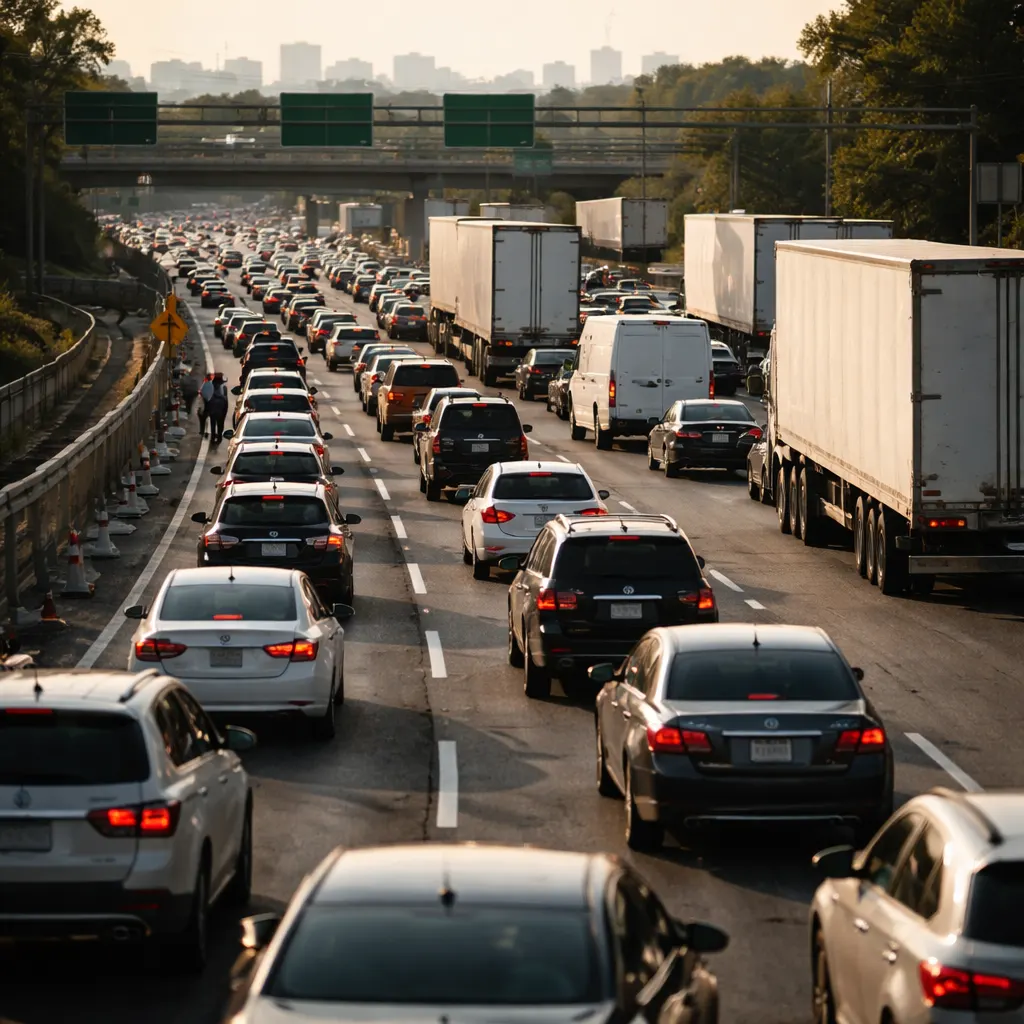
New Jersey drivers waste roughly 85 hours annually—more than two full workweeks—sitting in gridlock, according to Reason Foundation's 29th Annual Highway Report, which ranks the state dead last in the nation for urban traffic congestion. The report, which evaluates state highway systems across 13 categories including bridge safety, traffic fatalities, pavement conditions, and spending efficiency, places New Jersey 40th overall for highway cost-effectiveness and road conditions. That's a decline from last year's 34th-place ranking, though it represents significant progress from the state's bottom-tier finishes in previous years.
The state's struggles extend beyond traffic jams. New Jersey scores 42nd out of 50 states in urban interstate highway pavement condition and 41st in urban arterial road pavement condition, though it performs better on rural interstates at 17th place. On the safety front, the state fares reasonably well with the 14th-lowest rural traffic fatality rate and the 16th-best urban traffic fatality rate. Bridge conditions land near the middle of the pack, with New Jersey ranking 27th nationally in the percentage of structurally deficient bridges. However, the state ranks 44th in capital and bridge disbursements, meaning it spends far more per road and bridge project than nearly every other state. New Jersey also ranks 42nd in maintenance spending, which covers costs like repaving roads and fixing potholes. When compared to neighboring states, the gap is striking: Connecticut ranks 7th for road performance and cost-effectiveness, Delaware 32nd, Maryland 34th, and Pennsylvania 36th, while New Jersey only beats New York's 47th-place finish.
The report notes that traffic congestion carries real economic consequences beyond driver frustration. Time lost in gridlock reduces productivity, increases fuel consumption and emissions, and drives up shipping costs for businesses and prices for consumers, according to the study. The authors acknowledge that politicians and officials will point to the state's higher cost of living, harsh winters, proximity to New York, and other factors as explanations for above-average spending, but argue that justification only extends so far and the state should continue reforming how it prioritizes projects and allocates transportation dollars.
The report suggests that New Jersey's highway improvements don't require reinventing transportation policy. For quick gains, the state should focus on ensuring spending produces smoother pavement on urban roads and fewer structurally deficient bridges. Long-term, reducing traffic congestion must be a top priority. Smart investments in added capacity, better traffic management, and more effective use of technology could move drivers through the state's worst bottlenecks, boosting economic productivity and competitiveness. For a state with such a critical transportation network that millions rely on daily and businesses depend on to move goods across the Northeast, New Jersey has made some solid gains in recent years—but still has significant work ahead.