
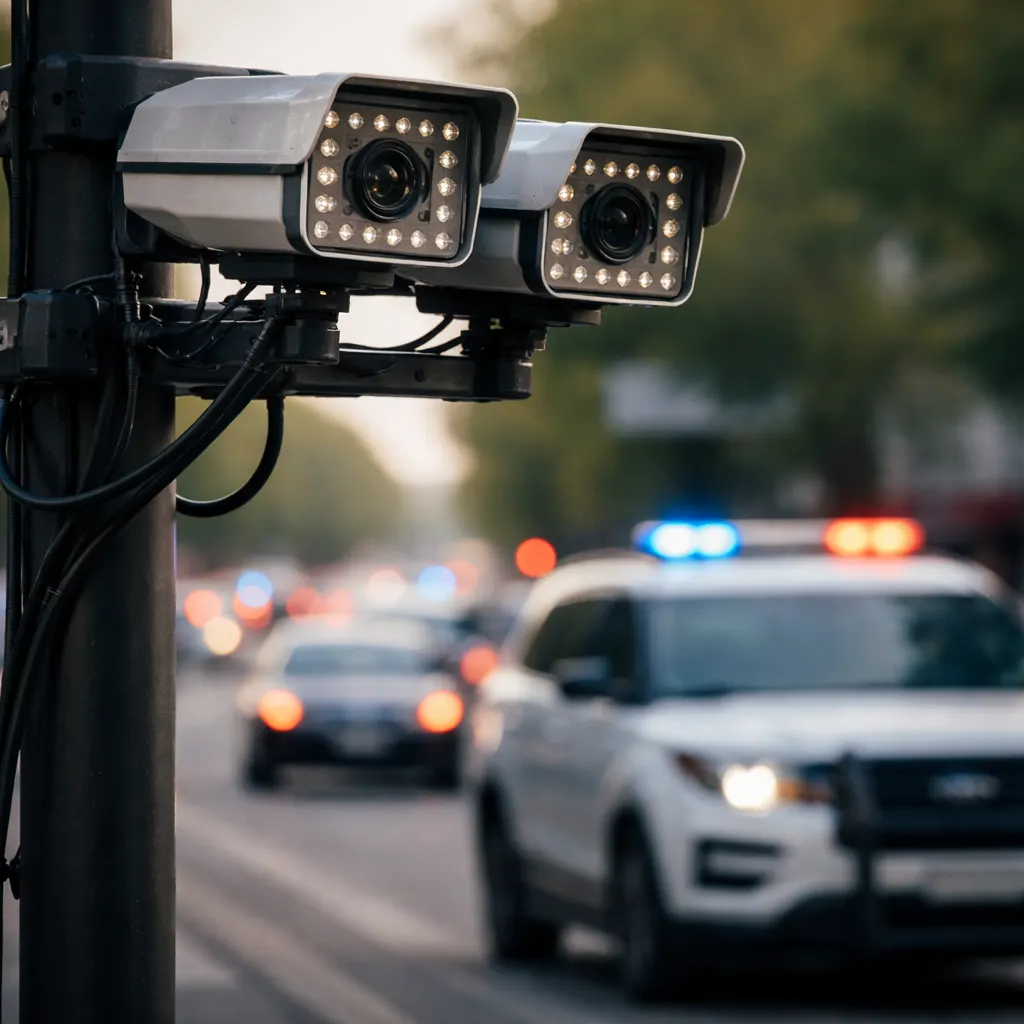
Two new Michigan bills backed by the American Civil Liberties Union would force police to get a warrant before accessing data from automatic license plate readers, according to a report published by the Mackinac Center for Public Policy. The legislation, introduced in January, comes as surveillance cameras from industry leader Flock Safety face mounting criticism over privacy concerns and as Los Angeles prepares to let its contract with the company expire in mid-July. More than 125 Michigan cities and counties currently use Flock or similar systems, with about 4,000 cameras deployed statewide out of more than 106,000 across the United States, according to users of the website DeFlock.
House Bills 5492 and 5493 would regulate how police use data from the networked cameras, which capture not just license plates but also vehicle make, model, color, time of passage, and often speed. Under HB5492, government agencies could ask Flock and other camera companies to preserve data for at least 14 days, but only if the information were proven to a court to be relevant to an ongoing investigation or case. Anyone whose data was obtained without meeting legal requirements could sue for $1,000. HB5493 would limit government use of the technology to enforcing parking rules, identifying uninsured and stolen vehicles, and assisting with ongoing criminal investigations. Agencies would have to post public policies on data usage and deletion. The bills are tie-barred, meaning one can't pass without the other, and both remain in the House Committee on Judiciary.
The report notes that Flock's systems are "more technologically advanced than earlier police cameras" because they "convert routine observations into coordinated searchable databases" rather than simply recording a specific area. By 2019, Flock had captured 10 million images in a single day, and by 2024 the company's technologies "helped solve more than 10% of all crimes committed nationwide," according to Flock's own claims. The ACLU and allied groups have raised alarms about "potential security breaches, improper installation, and misuse of networked surveillance by rogue police officers," according to the report. The civil liberties organization has also criticized recent changes to Flock's terms of service, published in February 2026, that grant the company "a perpetual license to use stored data even if its relationship with a city ends" and enhance its legal protections.
The legal debate centers on whether people can expect privacy in public spaces when modern technology creates detailed maps of their movements. In the 2018 Supreme Court case Carpenter v. United States, justices ruled that police need a warrant to access historical cellphone location data because it reveals "extremely sensitive information about a person's life beyond easily obtainable information involving movement and attendance patterns." That ruling was narrow and didn't address plate readers directly, but it showed the court considers certain modern surveillance intrusive enough to require probable cause. A 2026 federal appeals court case in Mississippi, United States v. Porter, reached the opposite conclusion for plate readers, holding that cameras collecting "only limited location data with a small, fixed number of cameras" don't violate the Fourth Amendment. But the report suggests that ruling leaves room for courts to find that "broader and denser surveillance measures raise strong Fourth Amendment concerns."
The report frames Michigan's proposed legislation as "a step in the right direction" and argues the state has "a unique opportunity to become a national leader by honoring citizens' concerns, ensuring this new technology does not violate Fourth Amendment freedoms." With the number of readers growing exponentially and courts still divided on constitutional limits, the bills represent an effort to set guardrails before surveillance infrastructure becomes too entrenched to regulate. The outcome could determine whether Michigan residents can be tracked across thousands of cameras without judicial oversight or whether their movements remain protected by the same privacy standards that now apply to their cellphones.