
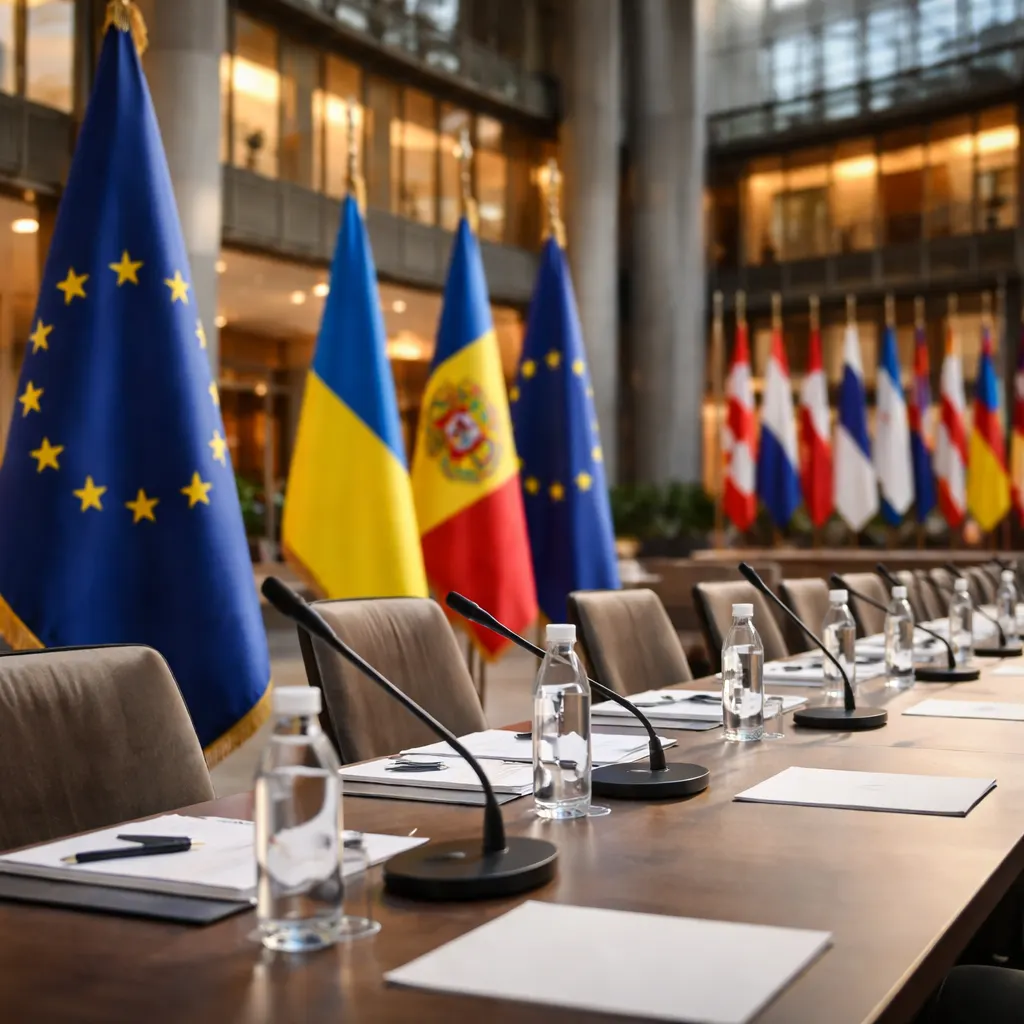
The European Union is unprepared to absorb Ukraine and Moldova despite opening formal accession negotiations, and admitting them would almost certainly require a new treaty to address fundamental institutional challenges, according to a report published by the Hudson Institute. The analysis warns that while most attention has focused on Ukraine and Moldova's ability to meet EU standards, European leaders have failed to do the hard work of preparing the bloc itself for expansion. If Ukraine joined, it would become the EU's fifth-largest member by population, fundamentally shifting the center of gravity in EU decision-making eastward and reducing Western Europe's long-enjoyed influence.
The report lays out three major institutional questions Brussels must address before enlargement can succeed. First, the European Parliament currently has 720 seats, meaning absorbing Ukraine would require existing member states to lose seats or the EU to expand the parliament. Second, Ukraine controls about a quarter of Europe's farmland, which under current Common Agricultural Policy rules could shift tens of billions of euros in subsidies from west to east—pushing an already contentious issue to the top of the EU agenda. Third, qualified majority voting in the European Council is partly based on population and requires support from member states representing at least 65 percent of the EU's total population. Ukraine's addition would place it as the fifth-largest member, followed by Poland and then Romania, fundamentally altering how decisions get made.
Moldova and Ukraine were granted candidate status in 2022, and formal accession negotiations launched in June 2024, but substantive negotiations only opened last month. The report notes that candidate countries must align with the acquis communautaire—the EU's body of laws and regulations spanning 35 chapters covering everything from rule of law and public procurement to agriculture, transport, energy and the environment. Turkey has been a candidate since 1999 and began negotiations in 2005, yet it has provisionally closed only one chapter, illustrating how laborious the process is in practice. For Ukraine, the report emphasizes, carrying out difficult reforms while fighting for national survival will be no easy task.
The analysis explains that full membership will likely take significant time not because of Moldova or Ukraine's potential or readiness, but because of the EU's institutional unpreparedness, especially for a country as large as Ukraine. Bringing into the EU a country fighting a major war against Russia will be politically, financially and institutionally difficult, the report states. Moldova faces the matter of Transnistria, the Russian-occupied breakaway region under Russian influence since the early 1990s. The Common Agricultural Policy, introduced in the 1960s, still accounts for roughly a third of the EU's long-term budget, with amounts each country receives heavily influenced by the size of its agricultural sector and farmland—making Ukraine's quarter share of Europe's farmland a potentially explosive issue.
Ratifying a new treaty appears politically unrealistic given current European dynamics, according to the report. The last major EU treaty was the Lisbon Treaty, which entered into force in 2009 and was not easy to ratify—Irish voters initially rejected it and had to vote a second time before approving it. With euroskepticism and populism on the rise, the idea that all 27 member states could agree on and ratify a new treaty to make enlargement work seems politically unrealistic. Yet the report argues more attention should be placed on European leaders doing the hard work now to prepare the EU itself, because if a lasting settlement with Russia is ever agreed, Ukraine's economic, industrial, agricultural and military potential will be enormous. Europeans need to work just as hard as Ukrainians and Moldovans to ensure that future enlargement happens as smoothly as possible.