
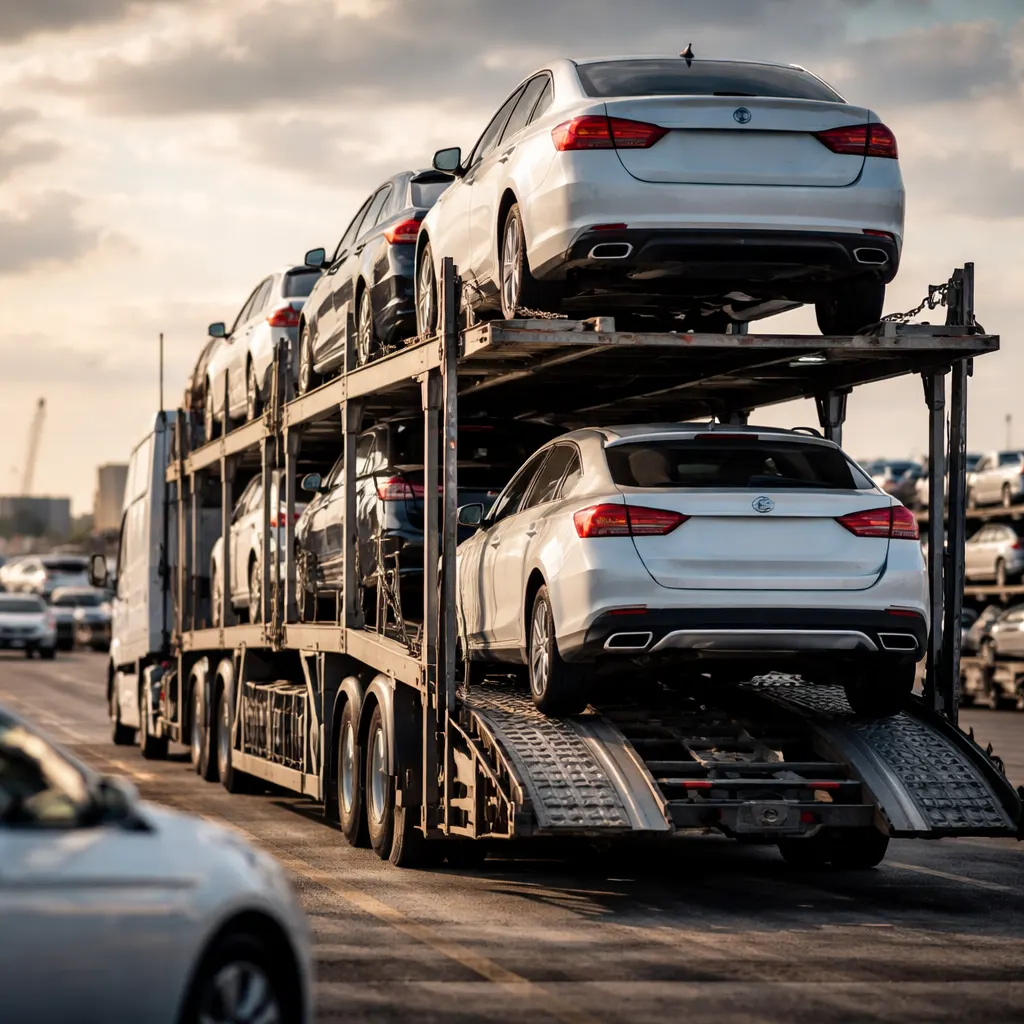
The journey of a new car from factory to driveway involves a sophisticated but increasingly vulnerable global logistics network that moves up to 18 million vehicles annually in the U.S. market alone, according to a new report from the Federal Reserve Bank of Chicago. The global automotive logistics industry is valued at roughly $113 billion, coordinating ocean carriers, freight railroads, vehicle processing centers, and specialized car haulers to deliver vehicles assembled across multiple continents. While vulnerabilities in auto parts supply chains are widely known, the report warns that the finished vehicle distribution system may be more fragile than it appears—with implications for both policymakers and consumers.
In 2025, nearly 55% of vehicles sold in the United States were made domestically, with over 77% coming from plants in North America, including Mexico and Canada. The Seventh Federal Reserve District—covering Illinois, Indiana, Iowa, Michigan, and Wisconsin—produced 30% of all U.S. light vehicles in 2025, along with 16% of engines and 35% of transmissions. Mexico, Canada, Japan, South Korea, and Germany supply the majority of imported vehicles. Roughly 75% of all new cars and light trucks sold in the U.S. travel by rail for at least part of their journey, with specialized autorack train cars capable of moving up to 800 vehicles per trip. Roll-on/roll-off ocean vessels, which have a median capacity of 6,200 vehicles, take 14 to 18 days to transit from Asia to the West Coast or Europe to the East Coast, with journeys to the opposite coast via the Panama Canal requiring about a month.
The report finds that the supply chain is "geographically concentrated at several critical nodes—ports, rail terminals, and VPCs", creating concentration risk where infrastructure failures or labor actions can quickly reverberate throughout the system. According to the analysis, all six major U.S. freight rail networks connect in Chicago, making it highly likely that vehicles pass through the city en route to customers. The report notes that when 25% import tariffs on finished light vehicles were introduced in 2025, some automakers briefly paused production and logistics planning to assess cost implications, demonstrating the system's trade policy sensitivity. There's also an acute truck driver shortage in the car-hauling segment, partly because skill requirements and operational complexity limit the pool of qualified drivers.
The report explains that these vulnerabilities stem from the system's efficiency-driven design. Vehicle manufacturers operate on tight inventory cycles because excess finished vehicles represent significant carrying costs and damage risks, meaning there isn't much buffer capacity at holding or dealer lots. The 2020 Covid-induced halt to North American vehicle production demonstrated how disruptions propagate downstream—the entire outbound chain was idled and wasn't easy to restart. Automakers have responded to increased tariffs by ramping up nearshoring strategies, locating production closer to the U.S. consumer base to reduce ocean-shipping lead times. But these efforts create new dependencies on ground infrastructure and North American cross-border logistics capacity that may need investment to handle additional volume.
Looking ahead, the report identifies the growing share of electric and hybrid vehicles as a factor reshaping both production geography and the logistics map. Battery gigafactories are being located near final assembly plants to improve coordination, but battery inputs often come from very different locations than traditional parts and may travel through different ports. Additionally, shifting more volume to direct-to-consumer sales—which some manufacturers are testing subject to state laws—has implications for dealership infrastructure, car-hauling capacity, and the geography of vehicle processing centers. The destination charge on a new vehicle's window sticker covers all these upstream transport costs, but what consumers don't see is a complex, policy-sensitive logistics chain that's currently in the early stages of a structural transition driven by vehicle electrification and shifting buying behavior.