
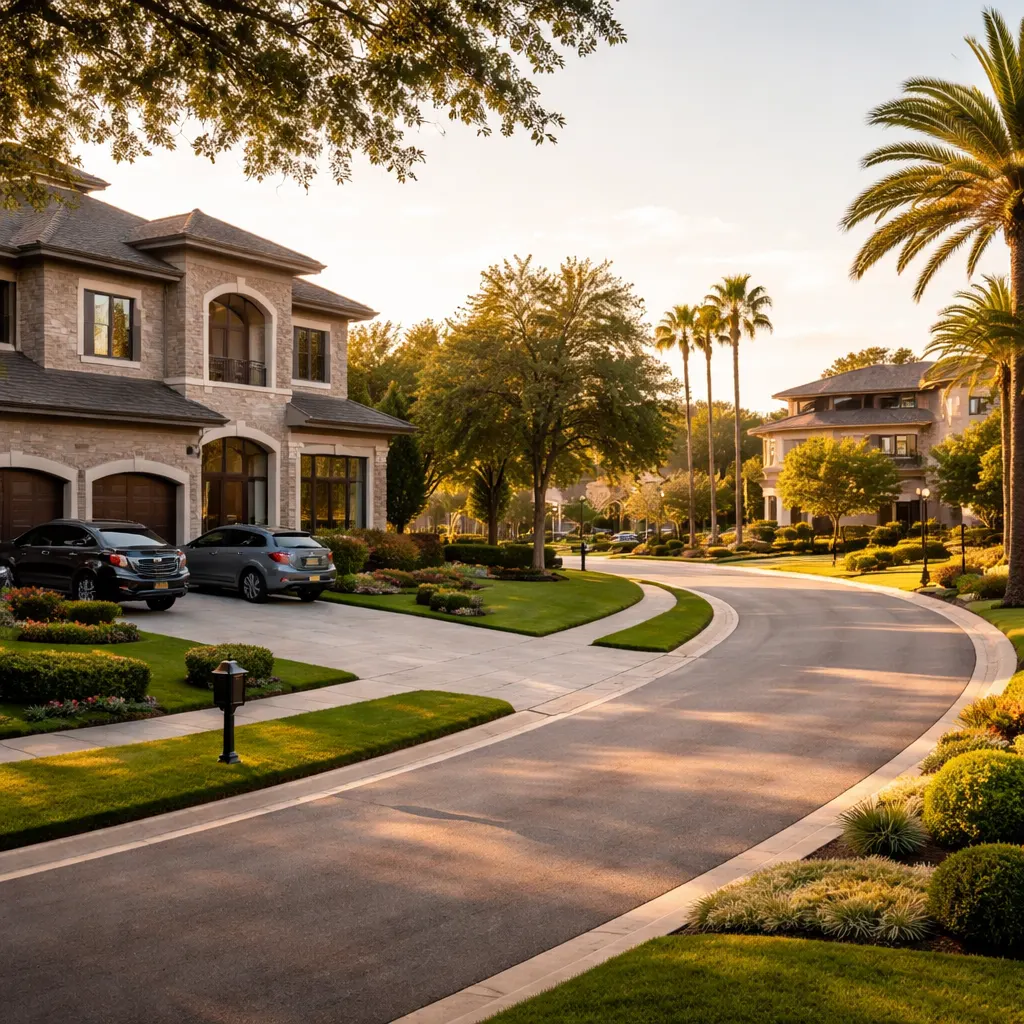
As America celebrates its 250th birthday, here's a striking paradox: its most prosperous neighborhoods are barely 25 years old. According to new analysis published by the Economic Innovation Group (EIG), when a neighborhood was built turns out to be a pretty good predictor of the economic well-being enjoyed by its residents. Using the organization's Distressed Communities Index — which measures educational attainment, workforce participation, poverty, incomes, housing vacancies, and employment trends across nearly every zip code in the United States — the research reveals a distinct relationship between neighborhood newness and prosperity.
The data paints a clear picture of geographic inequality driven by housing age. The average zip code built out in the 2010s posts a distress score of only 16.7, firmly in the prosperous quintile. It stands more than 35 points ahead of the average zip code built out in the 1980s, and enjoys a nearly 45-point lead over the oldest neighborhoods. For every one prosperous "historic" neighborhood — defined as a zip code where the median residence was built in the 1940s or earlier — there are three categorized as distressed. The disparity is stark in major metros: across the Dallas-Fort Worth area, 1.16 million new housing units have been built since 2000, with 677,000 rising in prosperous zip codes compared to just 72,500 in distressed ones. Very few housing units have been constructed in distressed communities in the past 15 years, and one-fifth of distressed community housing stock predates 1940. Meanwhile, 41 percent of all housing units built since 2020 have risen in prosperous communities, while only 8 percent have risen in distressed ones.
The report documents dramatic regional variations that underscore how rare prosperous historic neighborhoods are. Pennsylvania has 14 distressed historic zip codes for every one prosperous one, and Missouri has 18. In Ohio, more than half of the state's nearly one hundred historic zip codes are outright distressed, with only eight prosperous ones. The authors contrast emblematic cities like Buffalo, New York, and Gilbert, Arizona, which have approximately the same population but couldn't be more different: only 4 percent of all housing units in Buffalo have been built since 2000, while in Gilbert, 56 percent of all homes have been constructed since 2000. The report notes that in Chicago, one prosperous historic spot lies downtown and three comfortable zips line Milwaukee Avenue, yet they're far outnumbered by 16 deeply distressed zip codes across the city's South and West Sides with housing of similar vintages.
The determining factor, the report explains, is investment. Some historic neighborhoods have retained their value and received ample upgrades over the years, but this feat doesn't come easily for the typical neighborhood as its housing stock fades into obsolescence. The other way investment flows is through new builds, and by definition, an old housing stock is synonymous with a lack of new housing construction. Where new housing gets built follows a distress-prosperity gradient, but it also reinforces that gradient by channeling new investment, new residents, and new incomes into already-growing and well-off places. The report emphasizes that Gilbert benefits from being in a part of the country almost completely unencumbered by history, while Buffalo suffers from the weight of it — saddled with legacies of segregation and deindustrialization. Unencumbrance makes it easier for new Sun Belt cities to thrive, just as the burdens of the past — which include zoning codes and other administrative accretion — make it harder for their Rust Belt cousins to renew.
The tight connection between place and opportunity at the nation's semiquincentennial reflects a deeper policy failure, the report concludes. The authors write that public policy choices, not just private economic calculations, help explain why the U.S. economy is much better at building prosperous communities from scratch than it is at sustaining prosperity in legacy neighborhoods. Millions of Americans are mired in low-investment, low-opportunity neighborhoods, and many aging neighborhoods find themselves battling deteriorating social and economic conditions because they're structurally and administratively unable to renew. The fact that building is so hard in many corners of the country contributes directly to the lack of economic opportunity in them. As the nation turns 250 years old, there's much it can learn from its youngest places — and the older ones that have managed to rejuvenate.