
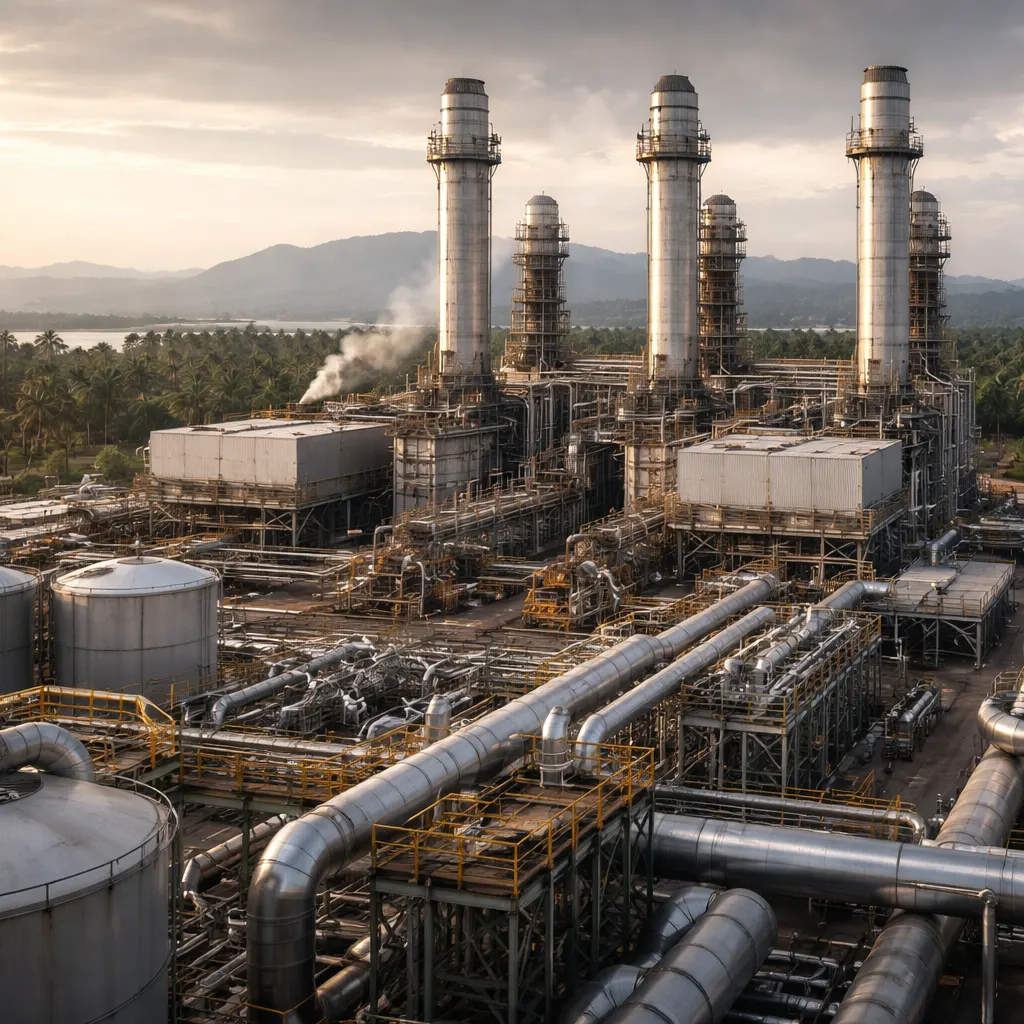
Southeast Asia will deliver less than one-third of its planned gas-fired power capacity by 2030, according to new research from Wood Mackenzie published this week. Governments across six major power markets in the region are aiming for roughly 53 GW of new gas-fired generation by the end of the decade, but the consultancy forecasts only 14.9 GW will actually reach commercial operation. The shortfall reflects a widening divide between policy targets and the realities of project execution, driven by turbine shortages, financing hurdles, volatile fuel costs, and infrastructure bottlenecks.
The data reveals significant gaps between ambition and reality across the region. Vietnam faces the steepest challenge, with a government target of 29.4 GW but an expected delivery of just 3.7 GW. Malaysia is targeting around 9.4 GW of new capacity, while Wood Mackenzie expects 5.9 GW to come online, with nearly 5 GW of existing plants being extended through 2030 as a temporary bridge. Indonesia has secured turbine supply for only 200 MW of its planned 8.4 GW pipeline, the lowest proportion of any market analyzed. The Philippines faces immediate reliability concerns, with just 0.4 GW expected against a 2 GW government goal, while Thailand's draft plan calls for 1.4 GW but only 0.5 GW is likely to be built. Singapore remains the strongest performer, having secured turbine supply for all major projects expected before 2030, though its next procurement round for 1.8 GW of hydrogen-ready generation will test even its execution capabilities.
Only 11 GW of the region's planned gas-to-power pipeline has secured gas turbines, according to the report, with the remaining capacity likely facing delivery lead times of at least five years. "The challenge today is not planning power projects but executing them," said Alvin Tan, Southeast Asia power and renewables research analyst at Wood Mackenzie. The report notes that new gas-fired capacity depends on several critical enablers, including LNG infrastructure, project financing, and turbine availability, with a bottleneck in any one area capable of delaying an entire project. Wood Mackenzie forecasts that the region will become a net gas importer by 2033, with LNG projected to supply more than 80% of regional gas demand by 2050.
The execution challenges come as Southeast Asia's electricity demand is projected to grow 2.4-fold by 2050, outpacing China, Australia, and South Korea. The report attributes this surge to industrial expansion, the China+1 manufacturing shift, and rising investment in semiconductor production, electronics, and hyperscale data centers. Gas demand from the power sector is expected to more than double between 2026 and 2050, accounting for more than one-quarter of regional electricity generation by mid-century. Yet as project delays mount and supply chains tighten, the report finds that policymakers are being forced to rethink not only the near-term role of gas but also the long-term pathways to achieving energy transition goals.
The outlook suggests gas was once viewed as a key enabler of Southeast Asia's energy transition, capable of meeting rising electricity demand, supporting renewable energy integration, and maintaining energy security. Today, according to Wei Han Tan, Southeast Asia power and renewables research analyst at Wood Mackenzie, that assumption is being challenged. While gas turbine shortages have emerged as the most visible constraint, project timelines are also being affected by fuel availability, LNG infrastructure, financing, permitting, and equipment procurement. The region's ability to close the gap between ambition and execution will determine whether gas can still play its intended role in the energy transition, or whether alternatives must take on a larger share of the growing power demand.