
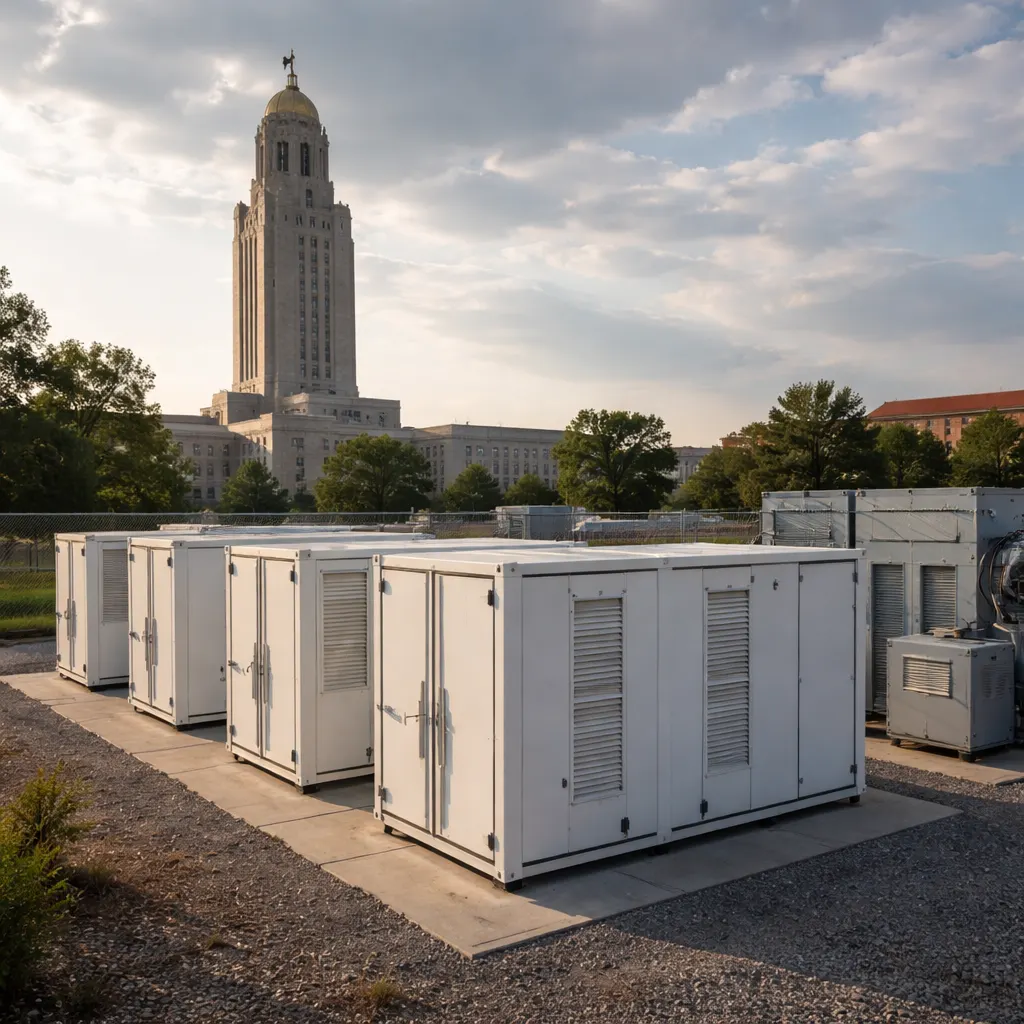
A 30-megawatt microgrid powering Nebraska's state capitol and other critical facilities is adding a 3-MW/12-MWh zinc-based battery, marking the first grid-scale battery energy storage project for Lincoln Electric System, the city's municipal utility announced earlier this month. The installation will boost the microgrid's capacity by roughly 10% and is now in final commissioning, with commercial operations expected to start within weeks. The project reflects growing interest among U.S. utilities in zinc and other alternatives to lithium batteries as demand for energy storage surges nationwide.
The battery will work alongside existing microgrid assets including a dual-fuel combustion turbine running mostly on natural gas, 300 kilowatts of customer-owned solar panels, and 500 kilowatts of customer-owned thermal energy storage, according to Scott Benson, LES director of strategy and innovation. The microgrid itself came online in 2020 and serves the state Capitol complex, a federal building, city offices, and two public safety facilities in downtown Lincoln. LES issued a request for proposals in late 2021 and selected Eos Energy Enterprises, a Pittsburgh-based manufacturer that has since expanded to gigawatt-scale supply contracts. At the time of selection, the Lincoln project was significantly larger than any battery Eos had in service or under development.
Benson said the utility will charge the battery when energy demand is low and discharge it during peak load and price periods to cut peak demand, add operational flexibility, and boost the value of wind assets that make up more than half of LES's generation portfolio. The Eos proposal offered the "lowest per-unit cost" over the contract period, plus chemical stability that LES viewed as a benefit for the urban location. "This thing is essentially non-flammable, which is important because it's built to go in a dense urban environment," Benson told Utility Dive. He added that it's "neat to be able to play a part in helping a really new technology getting out there and gaining a foothold."
LES began exploring energy storage in the late 2010s but initially couldn't find a pressing need on what Benson described as "a really reliable system" that historically peaks around 800 MW of load. That calculus shifted when the downtown microgrid launched in 2020, creating what he called "a potential marriage" between the two technologies. The utility has no immediate plans to install additional batteries, zinc-based or otherwise, though Benson noted that "things can change in a hurry" as generating equipment ages, new loads emerge, and market rules evolve. Like a community-scale solar array LES deployed in 2016, the microgrid battery will familiarize the utility with a technology rapidly becoming central to the U.S. power sector, positioning it to evaluate batteries in future resource plans.