
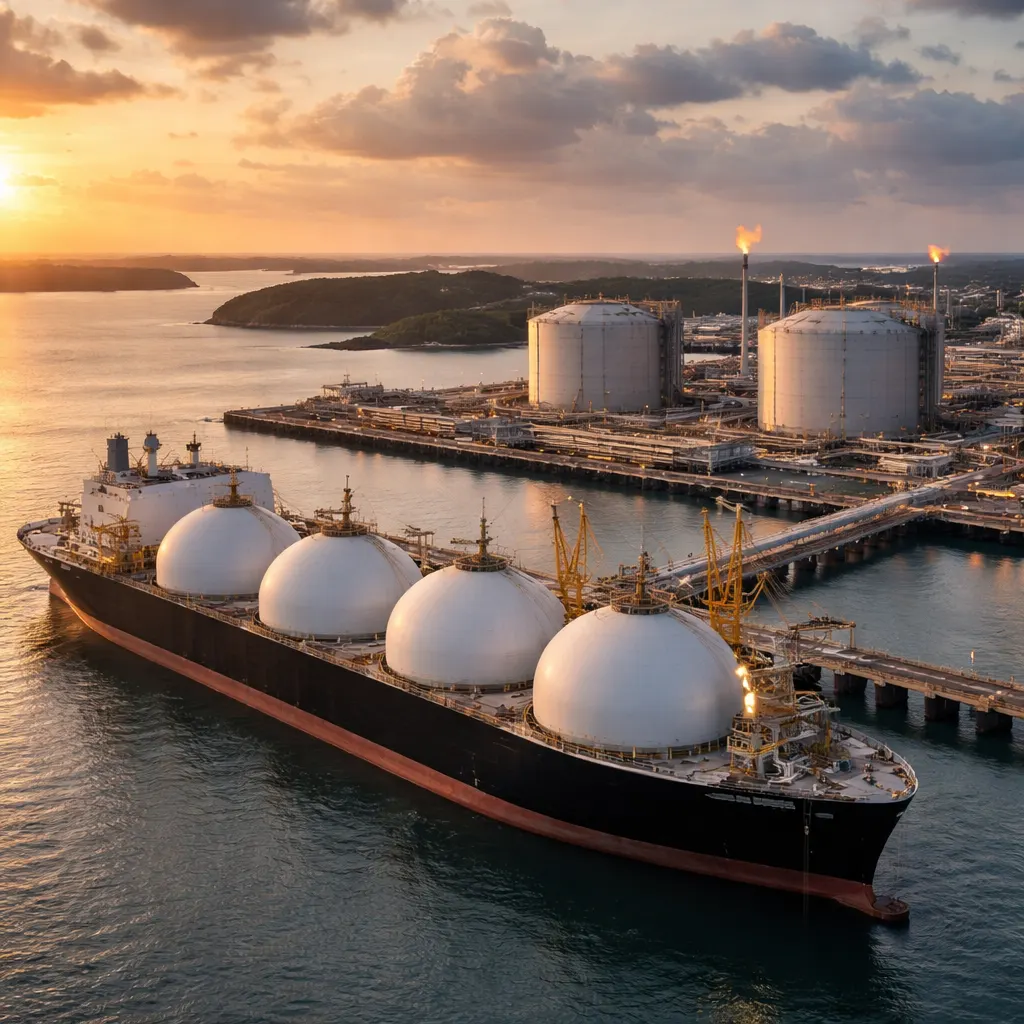
Mozambique is poised to become Africa's largest liquefied natural gas exporter by 2032, overtaking Nigeria, if its four current projects deliver 38 million tonnes per annum of capacity, according to a new analysis published by Wood Mackenzie in October 2026. The country's energy sector is experiencing a dramatic turnaround five years after regional violence in Cabo Delgado province forced TotalEnergies to suspend construction of its flagship onshore facility. The Coral Sul floating project is now operating at full capacity, Coral Norte has received investment approval, construction has resumed at Mozambique LNG, and Rovuma LNG is approaching a final investment decision.
Wood Mackenzie projects that roughly $45 billion could flow into Mozambique between 2026 and 2033 to finish Coral Norte and the two onshore facilities. But that's likely just the beginning: the firm estimates that around 75 trillion cubic feet of gas remains undeveloped across Areas 1 and 4, sufficient to support a second phase of Mozambique LNG, a third floating vessel in Area 4, and potentially a joint project spanning both blocks. These follow-on developments could add 30 to 35 million tonnes per annum of capacity and push national output above 70 million tonnes annually by 2040. That volume would be enough for Mozambique to surpass Canada and rank as the world's fourth-largest LNG producer, while total investment climbs beyond $90 billion between 2026 and 2040. Mozambique's exploration surge in the early 2010s discovered 125 trillion cubic feet of reserves across the two areas, enough to support separate LNG facilities in each block.
The report notes that Coral Sul, the world's fifth floating LNG project, has maintained its 3.4 million tonnes per annum capacity since hitting peak production in 2023, giving Area 4 partners confidence to approve Coral Norte, which targets first deliveries in 2028. TotalEnergies sanctioned the 13.1 million tonnes per annum Mozambique LNG project in 2019, but security concerns triggered four and a half years of force majeure before construction resumed in January 2026. The project is now approximately 45 percent complete, with TotalEnergies aiming for start-up in 2029. According to Wood Mackenzie, ExxonMobil's Rovuma LNG was reconfigured during the delay, swapping two large processing units for 12 smaller ones to boost capacity to 18.6 million tonnes per annum, with the project expected to cost around $27 billion and become Africa's largest-ever energy development.
The stakes are particularly high for international operators and Asian buyers. Wood Mackenzie calculates that Mozambique could represent 16 percent of Eni's upstream value by 2030, while the country could become TotalEnergies' most valuable African holding and CNPC's most valuable position globally if all four approved projects and subsequent phases move forward as planned. East Africa's location outside the Persian Gulf, combined with shorter shipping distances to South Asian markets, has made Mozambique increasingly appealing as recent geopolitical disruptions reshape buyers' risk assessments. Both Area 1 and Area 4 include Asian national oil companies among their non-operating partners, including CNPC, PTTEP, three Indian national oil companies, and ADNOC's XRG.
Yet the report emphasizes that execution risk remains substantial. Conditions in Cabo Delgado have improved but aren't fully stable, government approvals for Mozambique LNG's revised budget and Rovuma LNG's updated development plan are still pending, and Mozambique's newly amended Petroleum Law creates additional uncertainty around domestic gas requirements and pricing. Financing may prove the toughest challenge: Wood Mackenzie estimates that total capital expenditure could exceed $75 billion if Rovuma LNG and the three follow-on projects proceed, with roughly $50 billion needed from external lenders. This funding will be required as more than 100 million tonnes per annum of new global LNG capacity is scheduled to enter the market by 2030, meaning every year of delay shrinks the window before that surge of new supply arrives.