
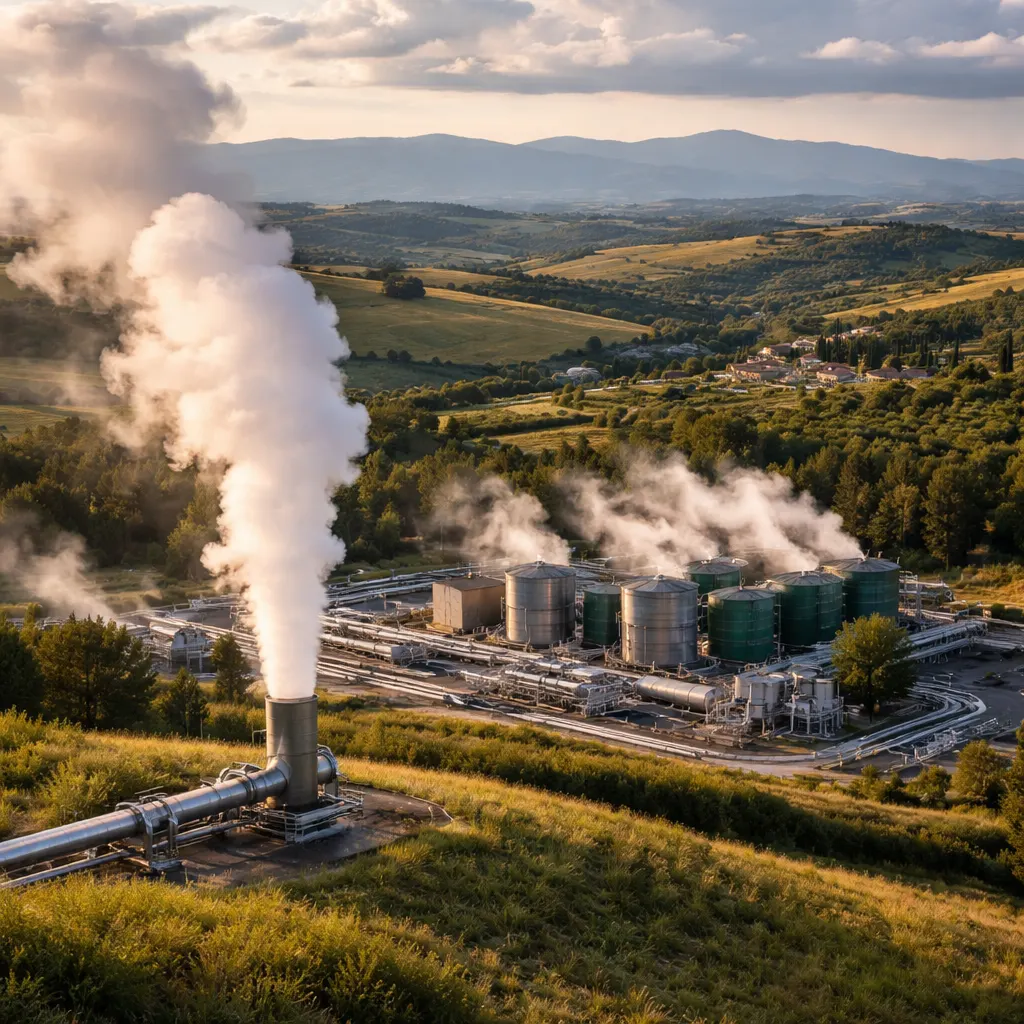
Italy's geothermal energy reserves stretch far beyond the country's volcanic zones, according to a new study published in the journal Geothermal Energy that offers the first systematic mapping of underground heat resources across the entire nation. The research, led by M. R. Galione and colleagues including A. Manzella and E. Trumpy, reveals that sedimentary basins in northern Italy hold significant untapped potential for heating and thermal storage, challenging the long-held focus on the country's traditional magmatic areas. The assessment introduces a standardized framework that could reshape how Italy and neighboring European countries plan their geothermal development.
The researchers identified twenty-seven distinct geothermal plays nationwide, organizing them into six primary categories split between convection-dominated and conduction-dominated systems. Volcanic, plutonic, and extensional domains form the convection-dominated group, while foreland basins, orogenic belts, and basement rock provinces make up the conduction-dominated types. From this national inventory, the team selected seventeen key play reservoirs for in-depth analysis, drawing on borehole temperature readings, lithostratigraphy, reservoir shapes, and petrophysical parameters from published sources. They calculated each reservoir's Heat in Place and, where data permitted, Heat Storage Potential for medium- and high-temperature aquifer thermal energy storage, relying on probabilistic Monte Carlo simulations to account for subsurface uncertainty.
The findings confirm Tuscany's traditional convection-dominated plutonic systems as exceptionally rich in geothermal potential, the same type powering all of Italy's existing geothermal electricity plants. Yet the study's central message concerns a different region entirely. Conduction-dominated sedimentary basins, particularly in the Po Plain of northern Italy, demonstrate substantial capacity for direct heat use and thermal energy storage, supported by large reservoir volumes and favorable rock properties. The authors conclude that because this play type is widely distributed across Italy, the nation's geothermal resources extend well beyond its established magmatic zones.
The standardized play-typing approach developed in the study allows direct comparison between Italian geothermal systems and geological settings elsewhere in Europe, according to the researchers. They describe the framework as a foundation for national energy planning, a tool for cross-border benchmarking, and a method for pinpointing priority targets for future exploration, direct heating applications, and large-scale underground thermal storage. By mapping Italy's full geothermal landscape for the first time, the assessment shifts attention from electricity generation alone to a broader vision that includes heating networks and seasonal energy storage—resources that could prove critical as Europe pursues decarbonization. The Po Plain's hidden thermal reserves may soon become as strategically important as Tuscany's proven power fields.