
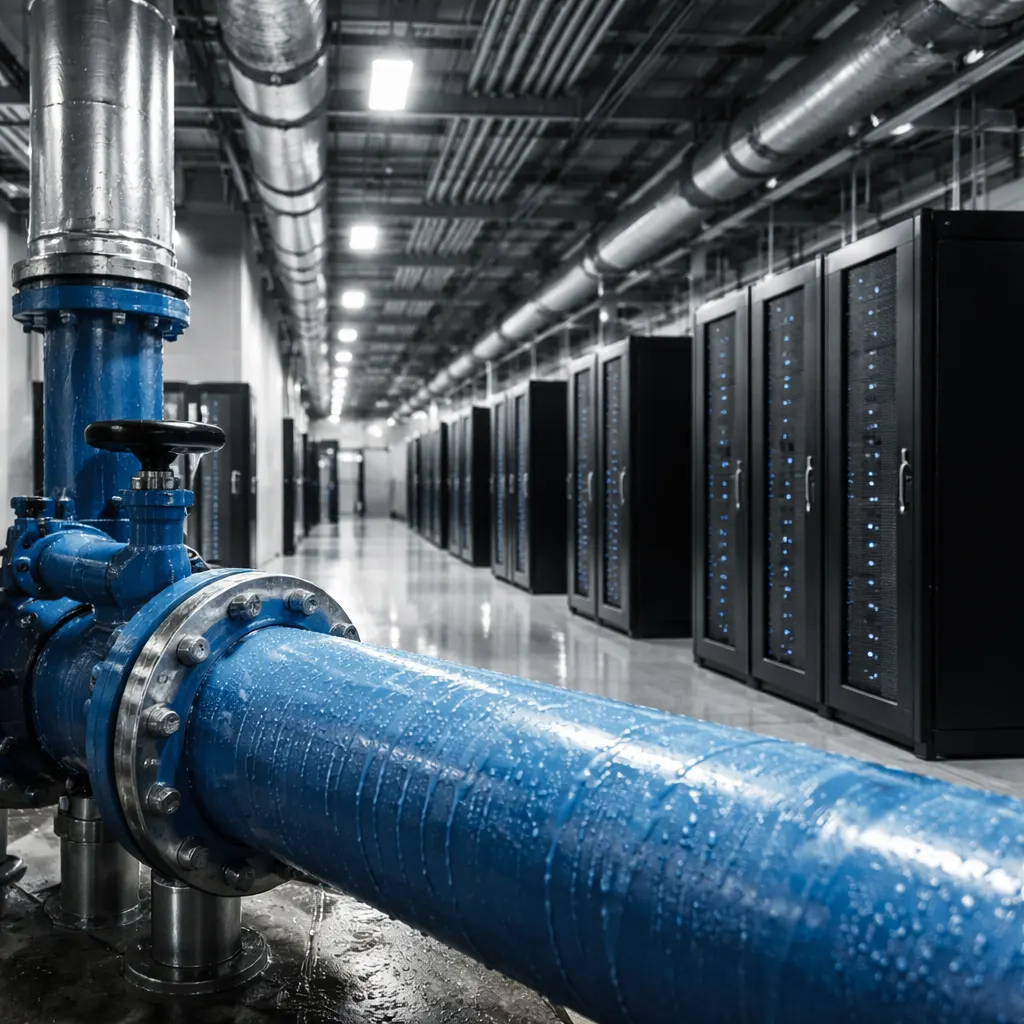
Data centers consume roughly 17.5 billion gallons of water each year, just 0.3 percent of the nation's total water supply, according to a new analysis from the Georgia Public Policy Foundation. The report argues that the growing movement to block data center construction over water concerns is misguided, and that electricity infrastructure represents the real challenge facing the industry. Opponents blocked or delayed 75 data center projects worth $130 billion in the first quarter of 2026 alone, citing water and electricity use among other worries.
The water consumption figures most commonly cited by activists reflect primarily the indirect, upstream water used by power plants generating electricity, not the facilities themselves, the report explains. When measured by direct water use—mainly for cooling servers—the industry's footprint shrinks dramatically. By comparison, California's almond industry consumes 1.3 to 1.6 trillion gallons annually, roughly 70 to 90 times the water used by all U.S. data centers combined. Meta estimates its new Richland Parish, Louisiana facility—a $50 billion, 5-gigawatt expansion of Project Hyperion that will become one of the world's largest AI campuses—will use approximately the same amount of water annually as the farmland it's replacing. Companies are also adopting less water-intensive designs, including closed-loop systems that need very little water after initial construction and servers capable of running at higher temperatures before requiring cooling.
The report finds that electricity demand, not water use, presents the more substantial concern. Data centers require utilities to construct new generation facilities and upgrade existing infrastructure, with these costs often transferred to consumers through rate increases. A recent Pew Research Center poll showed 38 percent of Americans believe data centers negatively impact home energy costs, while a Politico survey found half of Americans expect data center energy use to become a midterm campaign issue. The analysis notes that Meta claims it will cover the full infrastructure cost of electrifying its Richland Parish campus.
Until recently, data center growth was associated with moderately lower electricity rates because these facilities served as large, steady customers that spread utilities' fixed costs across a broader base, reducing average costs for everyone. American electricity demand remained largely flat from 2005 through 2025 despite the shift to a digital economy, thanks to the LED revolution, deindustrialization, and other factors. But permitting rules, renewable portfolio requirements, and the retirement of coal and nuclear baseload plants over the last two decades have weakened the grid's ability to add capacity now that demand growth has resumed. The report concludes that data centers simply exposed larger structural problems in the electricity industry that have made growth difficult and raised consumer prices.
Long-term solutions must include making it easier for data centers and other large electricity consumers to generate their own power more flexibly in response to changing market conditions, the report states. Many utilities are already adopting large-load tariffs that charge higher rates to data centers and other major users, shifting more fixed infrastructure costs onto the heavy consumers driving increased demand. Ultimately, data centers have become a stand-in for broader anxieties surrounding AI, including job displacement, distrust of Big Tech, and a sense of losing control of fast-moving technology—concerns that may be valid but represent a different debate than the one about water consumption and electricity rates.