
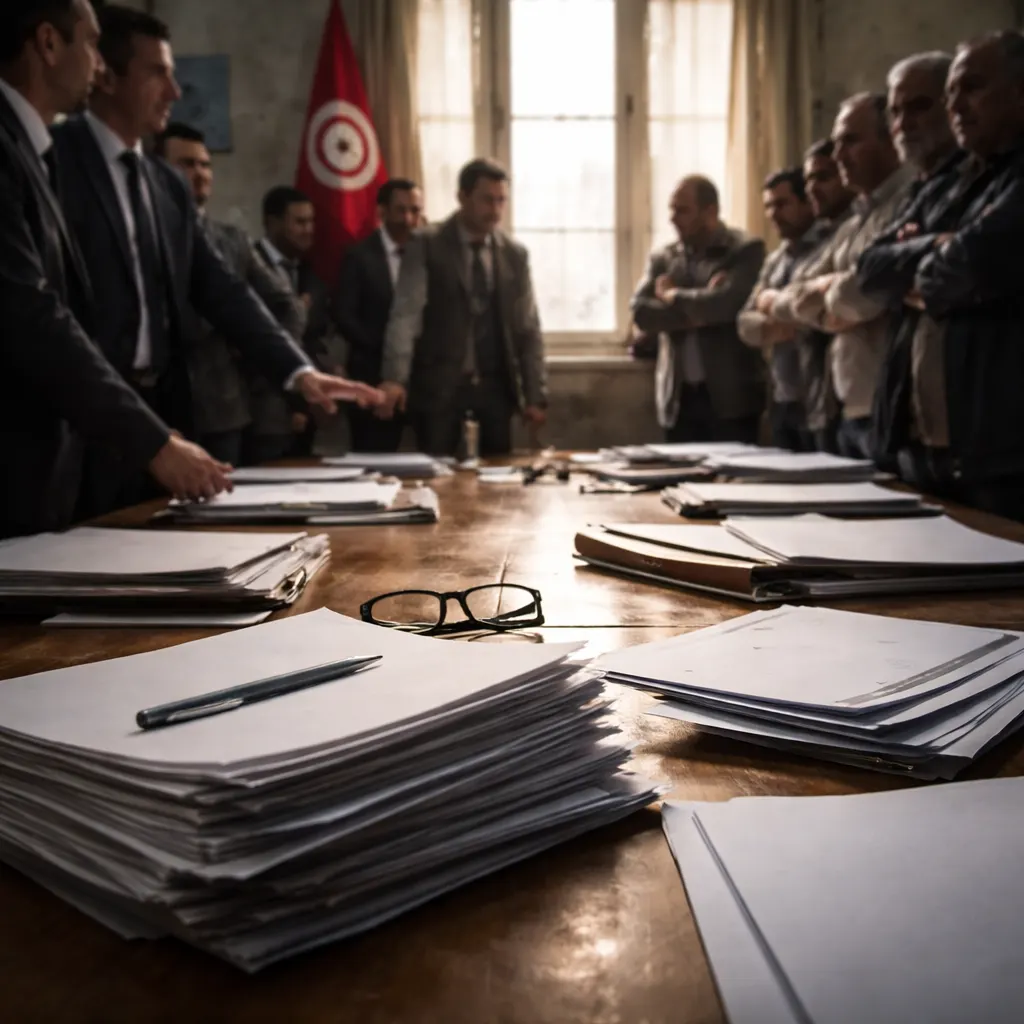
Education reform in Tunisia has reached a complete standstill since 2023, reflecting a deeper battle over authority between teacher unions and the government rather than just political turbulence, according to a new policy brief published by the Arab Reform Initiative in February 2026. The impasse followed a May 2023 agreement between the Ministry of Education and teacher unions that promised phased salary increases of 100 Tunisian dinars annually over three years starting in 2026, plus promotion measures with retroactive effect from July 2025. Despite these commitments, unions later accused the government of refusing to implement the deal or engage in meaningful dialogue, freezing progress on reforms the country desperately needs.
The consequences of this deadlock are already visible in classrooms and data. Tunisia's performance in the 2015 Programme for International Student Assessment ranked near the bottom globally—65th out of 70 participating countries—with scores of 361 in reading, roughly 367 in mathematics, and 386 in science, more than 115 to 130 points below the OECD average of approximately 490 to 493. Rather than address these troubling results, the Ministry chose not to participate in the 2018 test or any subsequent assessment cycles, effectively avoiding external scrutiny. Meanwhile, the government made an unprecedented move in 2025 by unilaterally deciding wage increases without consulting unions—the first time this had happened since the 1970s. Civil society organizations report that collaboration with schools depends entirely on individual school directors' personal attitudes, making partnerships occasional, informal, and impossible to scale nationally.
The report identifies the core problem as a clash over who holds legitimate authority to shape education policy. Teacher unions, historically a key part of the Tunisian General Labor Union, see themselves as guardians of public education based on their role in independence struggles, post-1956 nation-building, survival under the Ben Ali regime, participation in the 2011 Revolution, and mediation during the 2013–14 National Dialogue. This legacy has led unions to position themselves "not only as defenders of teachers' rights but also as legitimate actors in leading the direction of the education sector," the brief states. The Ministry of Education, by contrast, has reasserted its mandate to restore what it calls "state prestige and authority" and protect public interests, particularly after 2021 when President Kais Saied began strengthening executive control and curbing the influence of unions and other civil society actors. One workshop participant described current negotiations as "arm-wrestling sessions" rather than collaborative problem-solving, with both sides viewing concessions as signs of weakness.
The report warns that this stalemate is causing long-term damage across multiple dimensions. A "fear culture" has taken hold in which teachers avoid taking initiative because action outside officially sanctioned channels can trigger disciplinary measures, leaving educators feeling reduced to wage claimants rather than generation makers. The education system has become what one expert called a "migration pipeline" instead of a nation-building engine, with students and young professionals viewing emigration as the rational response to limited domestic prospects. A "two-speed" system has emerged in which private and international schools access advanced resources and modern teaching methods while public schools operate with minimal innovation and limited state support, entrenching educational inequality and creating cohorts whose learning opportunities are fundamentally uneven. Civil society access to schools remains profile-dependent and ad hoc, depriving the system of local and international expertise that could complement formal reform efforts.
The brief proposes a three-track framework to break the impasse, assigning specific responsibilities to unions, the Ministry, and civil society organizations. Unions should establish structured self-assessment mechanisms to reassess strategies and leadership practices while ensuring education dialogue remains open rather than monopolized by any single group. The Ministry should position reform within a broader national development vision, activate the Higher Council of Education, publicly release national education survey results, adopt open-governance collaboration with donors and researchers, ensure transparent resource allocation across regions, and support reforms with detailed implementation roadmaps including timelines and accountability tools. Civil society organizations should forge advocacy alliances with human rights groups and research institutions, create regional platforms bringing together local stakeholders for sustained dialogue, strengthen their mediation role connecting communities with state services, and continue community-based cultural activities promoting civic engagement. Without coordinated action across all three tracks, the report concludes, Tunisia risks ongoing human capital flight, deepening inequality, and what workshop participants described as education collapse gradually leading to the collapse of society itself.