
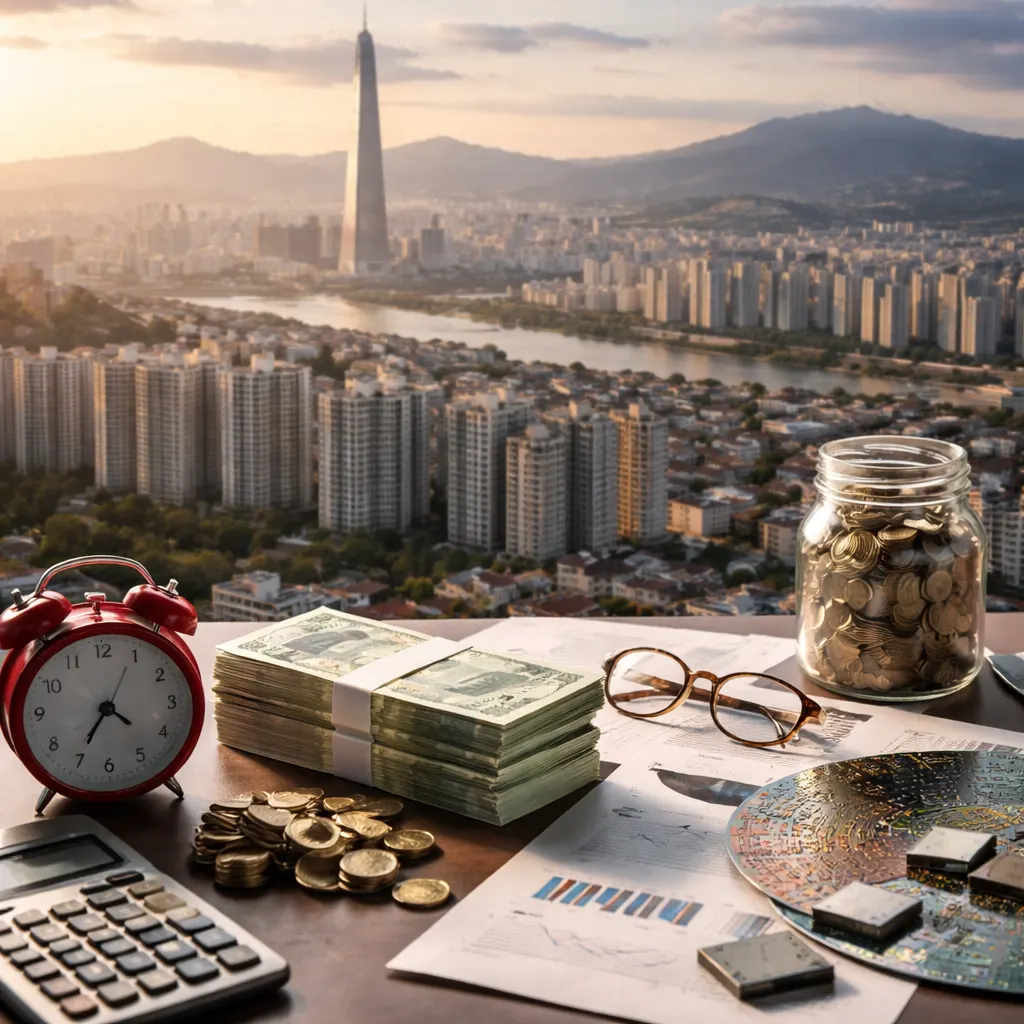
South Korea is unlikely to repeat its dramatic 1997 financial collapse, but it confronts a growing risk of prolonged economic decline driven by extreme reliance on semiconductor exports, household debt that reached KRW 1,978.8 trillion at the end of 2025, and one of the world's fastest-aging populations, according to an analysis published October 14, 2026, by Prof. Dr. Masahiro Matsumura of St. Andrew's University in Osaka. The report, published by the International Institute for Middle East and Balkan Studies, argues that while larger foreign-exchange reserves and currency swap arrangements totaling approximately $150.6 billion provide a buffer against sudden liquidity shocks, they can't eliminate the underlying weaknesses that could trigger a slow-burning structural crisis rather than a single dramatic event.
The country's export model remains heavily concentrated in semiconductors, which drive overall growth when global chip demand is strong but expose the economy to sudden weakness when the cycle turns, the report finds. The OECD projects growth will strengthen to 2.6% in 2026 and 1.9% in 2027, with semiconductor exports continuing to drive growth and private investment. South Korea's demographic trajectory presents equally severe challenges: the relative income poverty rate for people aged 66 and older stands at 40%, the highest among OECD countries. The nation's household credit burden reached KRW 1,978.8 trillion by the end of 2025, a level that makes the economy highly sensitive to interest-rate changes and income shocks while reducing consumption's ability to stabilize the economy during downturns.
According to Matsumura, South Korea holds substantial foreign-currency reserves and maintains a network of currency swap lines that reduce the probability of a sudden collapse of liquidity similar to the late-1990s crisis, but "reserves and swap lines should not be mistaken for structural self-reliance." The report emphasizes that these are emergency devices rather than substitutes for a balanced external position, and that a country with large reserves can still be highly exposed if its growth model depends heavily on external demand and its private sector carries significant debt. The analysis warns that the more likely risk isn't a sudden single-event collapse but "a slow-burning deterioration in which low growth, high debt, weak domestic demand, demographic contraction, and geopolitical uncertainty reinforce one another."
The report identifies chronic political reluctance to complete painful reforms in pensions, labor markets, and fiscal policy as a core vulnerability that compounds economic fragility. Every structural reform creates winners and losers, and governments often prefer temporary stabilization to long-term adjustment because the latter carries immediate political costs, resulting in reforms that are delayed, diluted, or only partially implemented. This pattern increases the chance that vulnerabilities accumulate slowly until they become politically and financially disruptive. The country's safety net also remains embedded in geopolitics: whether external support can be mobilized quickly during a crisis will depend on diplomatic relations with the United States, Japan, and China, making South Korea's crisis management capacity conditional rather than assured.
To reduce crisis risk, the report recommends South Korea strengthen its domestic demand base by reducing household debt dependence, supporting income growth, and improving productivity of small and medium-sized enterprises, while continuing diversification away from excessive reliance on semiconductors. Demographic policy needs to move beyond symbolic support for childbirth toward broader labor, housing, childcare, and immigration reforms, while fiscal and pension reform must be addressed before aging makes them far more expensive. The analysis concludes that if policy remains reactive rather than preventive, vulnerability will deepen, and the risk isn't only a financial crisis but "a broader erosion of economic capacity" that could result in prolonged national decline or, in the worst case, systemic collapse.