
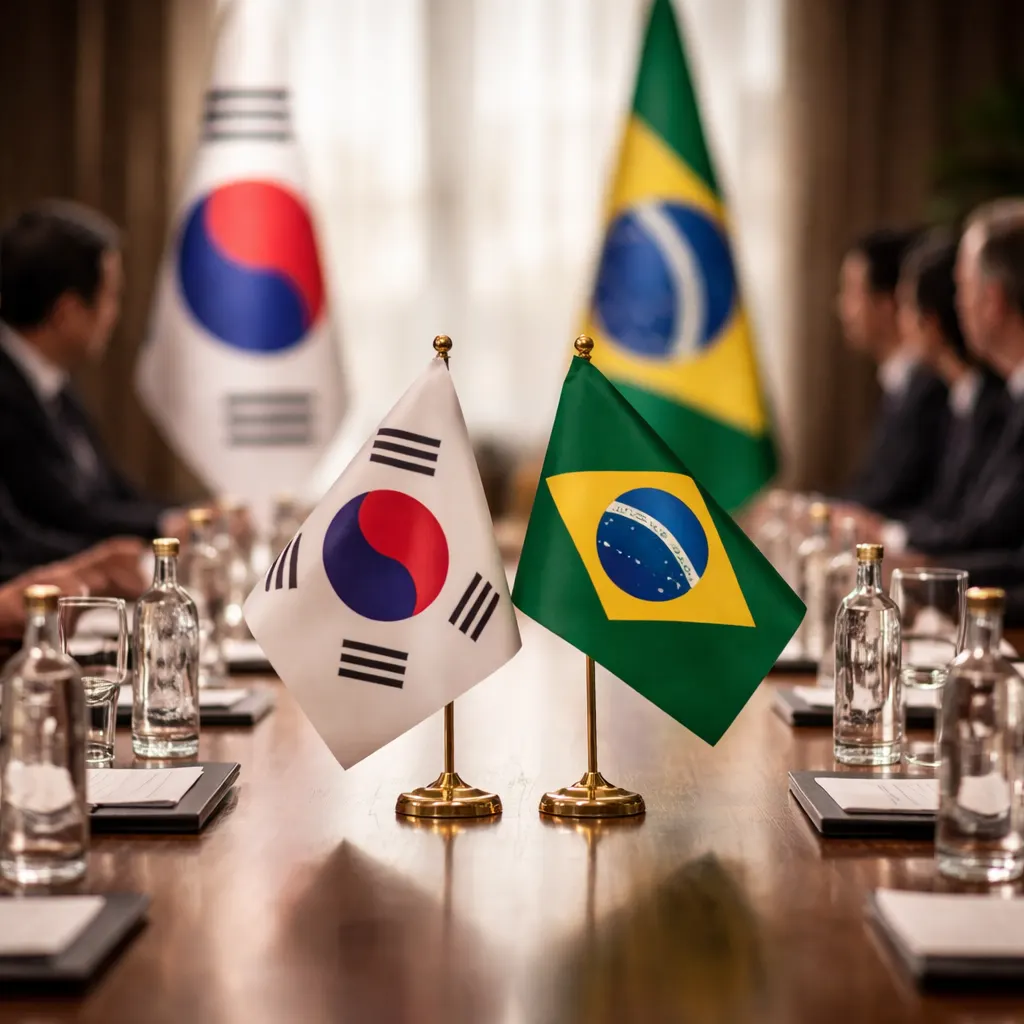
South Korean and Brazilian leaders have pledged to accelerate stalled trade negotiations, with President Lee Jae Myung calling an agreement "urgent" at a July 2026 summit, according to a new analysis published by the Foundation for Economic Education. Yet despite the political urgency, Brazil's own trade records show the seventh negotiating round—held in 2021—as the most recent, leaving five years of silence between the rhetoric and reality. The report examines how access to critical minerals has reframed discussions that originally opened in May 2018 but have since ground to a halt over technical disputes.
The bilateral trade relationship between the two nations reached approximately $10.8 billion in 2025, with Brazil exporting roughly $5.5 billion in goods to Korea and importing around $5.3 billion. Brazil's agricultural exports to Korea alone totaled about $2.4 billion in 2025, sending petroleum, iron ore, cellulose, soy, and meat in exchange for semiconductors, electronics, machinery, and vehicles. Since talks began in 2018, negotiators have tackled goods, services, e-commerce, investment, rules of origin, sanitary measures, technical barriers, intellectual property, and government procurement. The complementary nature of the trade—Korea as a wealthy food importer with advanced manufacturing, Brazil as a food exporter seeking investment—creates a strong economic case, but Brazilian industry groups remain wary of Korea's strength precisely where Mercosur's tariffs are highest: automobiles, steel, chemicals, and electronics.
The Foundation for Economic Education report notes that in March, Korean Trade Minister Yeo Han-Koo convened the four Mercosur ambassadors and emphasized the vast reserves of untapped lithium and nickel beneath Mercosur nations, leading to a July cooperation memorandum between Brazilian and Korean mineral agencies on "sustainable development of the mining sector." Brazil's National Confederation of Industries has stated its preference for "the suspension of negotiations on the Mercosur–South Korea agreement or, alternatively, defend a partial agreement that reflects the interests of the private sector in market access and rules, and protects sectors against unfair competition." The report characterizes the gap between political theater and technical progress as "unusually wide," with delegations of South Korean food safety officials now preparing extensive tours of Brazilian meat processing plants to inspect everything from chilling temperatures to drainage systems.
Critical minerals have become so vital that they've significantly rebalanced the entire trade discussion, the report explains. Selling soybeans means entering a market, but selling battery minerals means entering a production system that can't be easily reconfigured—making Brazil a vital supplier vulnerable to international disruptions while Korea secures minerals but becomes dependent in the process. The timing pressure has intensified as Mercosur launched economic partnership negotiations with Japan at the end of June 2026, introducing competition since Seoul and Tokyo's interests overlap almost exactly on vehicles, machinery, and rare-earth minerals. Brazil ran a 45-day public consultation on Korea–Mercosur trade from May 15 through early July, a move the report describes as "fascinating" in seeking a democratic mandate for a specific trade deal.
Despite the renewed activity—ministers meeting, working groups refining language, inspection delegations being dispatched—the report notes a conspicuous absence: no announced eighth round of negotiations. President Lula has expressed his preference for finishing in 2026, but this remains a political objective that economic reality might not validate. Until a Round 8 date is announced or a completion schedule set, the summits are best understood as an agreement to keep agreeing.