
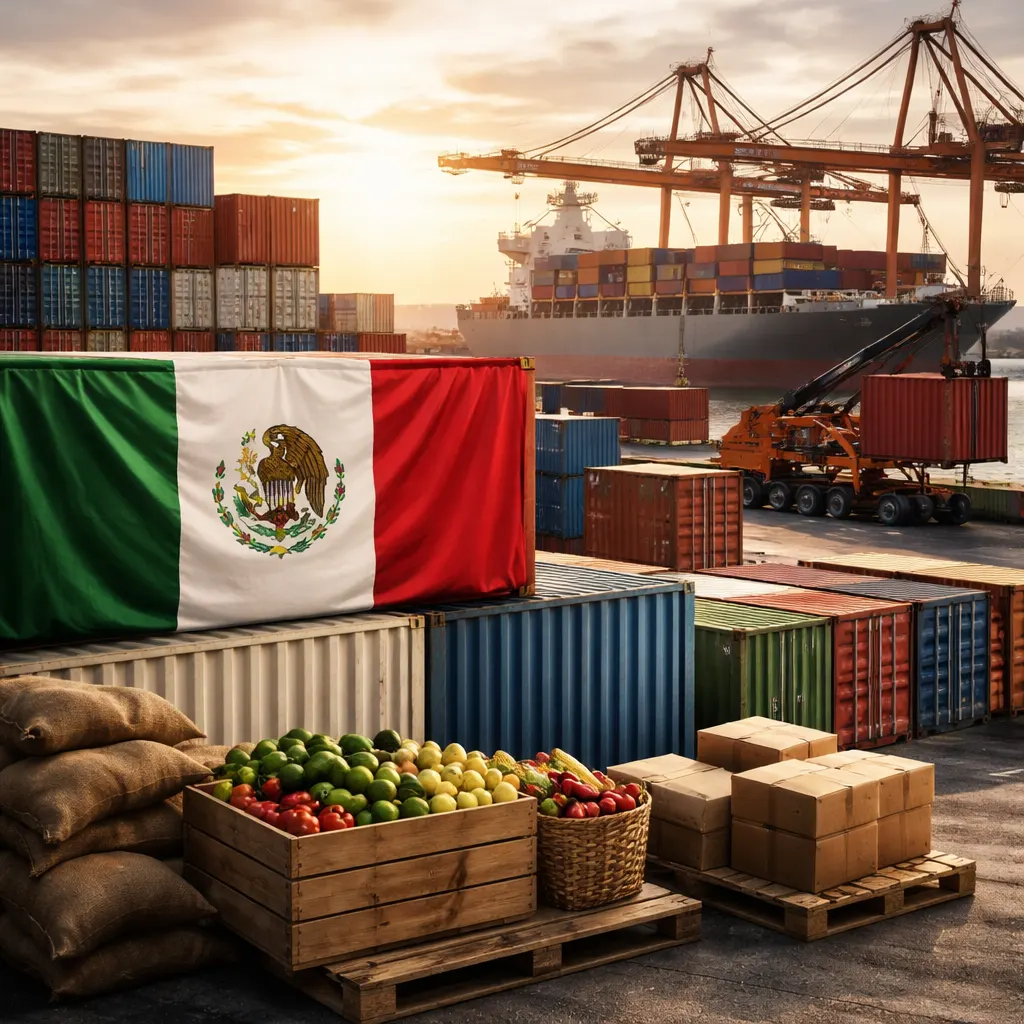
Mexico shipped more than $6.7 billion worth of goods to South America during the first half of 2026, marking an 18% jump from the same period a year earlier, according to a trade analysis published by Mexico Business News. The figures underscore Mexico's growing commercial presence in the region, while the country's deep ties to North American manufacturing networks position it as a potential bridge for Latin American firms aiming to reach U.S. customers.
Mexico's total exports to South America reached $12.84 billion in 2025, with four countries absorbing roughly 80% of those shipments. Brazil led the group with $4.66 billion, followed by Colombia at $3.21 billion, Peru at $1.23 billion, and Chile at $1.12 billion. The concentration highlights both the focus of Mexico's southern trade and room to grow relationships with other economies across the continent. The data arrives as companies increasingly view Mexico not just as a destination for finished products but as a manufacturing and investment hub.
The report notes that Mexico's participation in North American production networks creates a foundation for this commercial expansion, with automotive, electronics, medical device, and agribusiness firms integrated into supply chains linked to the United States. That industrial capacity is reinforced by Mexico's 14 free trade agreements spanning 52 countries, which together offer preferential market access and support the country's use as a platform for manufacturing and distribution. Concepción Valadez, CEO and G100 Country Chair Communications, Advocacy & Mediation, said Mexico's position allows it to "act as a platform for Latin American companies to expand their presence and compete in larger markets." The report also points to Peru as a concrete example: despite suspended diplomatic relations between the two nations, commercial ties have continued, and PROMPERÚ identified Mexico as the top Latin American market for Peruvian companies during the Peru Service Summit Mexico 2026, which has generated $147.6 million in business activity since its first edition.
According to the analysis, the opportunity extends beyond merchandise trade alone. Deeper regional integration could spark productive investment, supplier development, business alliances, and shared value chains, particularly in sectors capable of serving both Latin American and North American customers. For Mexican companies, South America offers a path to export diversification away from the heavy concentration on the United States, even though individual southern markets remain far smaller than North American trade volumes. The development of Mexico's role as a regional gateway will depend on energy availability, logistics infrastructure, connectivity, skilled labor, financing, and overall investment conditions, with advanced manufacturing, technology, financial services, energy, infrastructure, and logistics presenting strong opportunities for cross-border integration.
The report concludes that Mexico's economic goal is to leverage its industrial foundation and U.S. market access not only to draw capital but to increase participation by Latin American companies and suppliers in larger, cross-border value chains. Valadez framed the potential bluntly: "The opportunity is to build a deeper business relationship based on investment, value chains, innovation and strategic alliances." For South American firms, Mexico can serve as the stepping stone into North America, while for Mexico, the southern continent represents a strategically relevant export avenue that reduces dependence on a single trading partner.