
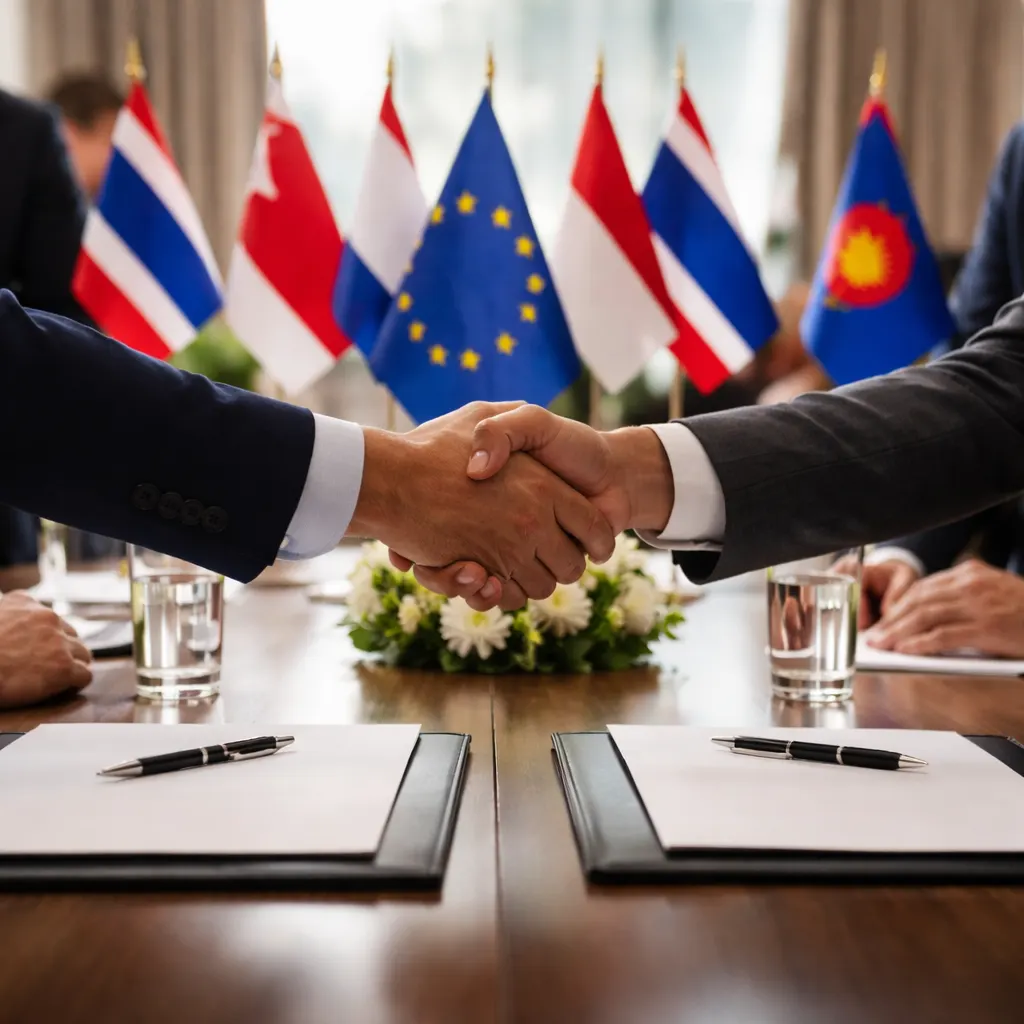
The European Union is constructing its Southeast Asian trade presence one country at a time, signing bilateral agreements that make a bloc-to-bloc pact increasingly unlikely, according to an analysis published by the Foundation for Economic Education on September 30, 2026. The strategy, which saw the EU and the Philippines agree on a free trade deal on September 22, follows a pattern Brussels has repeated across the region—but it undermines the comprehensive regional agreement both sides claim to want.
Two-way goods trade between the EU and ASEAN reached $318.8 billion in 2025, the joint statement from Manila records. The EU is already the third-largest trading partner for the ASEAN bloc and its biggest source of foreign direct investment. The Philippine deal grants exporters there permanent preferential entry to the EU market of approximately 450 million consumers, replacing the temporary preferences the country currently enjoys under the EU's General Scheme of Preferences Plus. Meanwhile, Washington's goods trade with ASEAN totals $550 billion, dwarfing Europe's footprint—Philippine ministers met with US representatives just two days before sitting down with EU negotiators. A survey by the EU–ASEAN Business Council found that 78% of respondents expect trade and investment in ASEAN to rise, suggesting capital is encouraged by the current arrangement.
The most tangible outcome from Manila was a set of digital trade principles the statement itself describes as non-binding, according to the analysis. Nowhere in the nine-paragraph joint statement is a region-to-region free trade agreement mentioned. Bloc-to-bloc negotiations opened in 2007 and were shelved within two years; a later review found the two sides' positions remained too distant, and in 2022 the working group tasked with sketching a future framework was redirected toward sectoral cooperation on digital, environmental, and supply-chain issues. In January 2026, the EU's ASEAN ambassador called a regional deal a long-term objective, signaling that talks were unlikely before 2027.
Brussels frames each bilateral agreement as a "building block" toward stronger region-to-region ties, but the analysis finds this creates a fragmented architecture rather than a unified foundation. Each pact is separately negotiated with its own tariff schedules, rules of origin, and sustainability provisions tailored to what a single government will accept—a concession granted to Manila doesn't apply in Bangkok. If a bloc-to-bloc agreement is ever negotiated, the first task would be reconciling half a dozen radically different texts by design. A European manufacturer supplying Philippine factories with Thai or Vietnamese components will find that where those parts count as originating depends on which agreement is invoked and what cumulation each permits—economists call this a "noodle bowl," but for exporters it creates additional regulatory burdens that fall lightest on firms large enough to afford legal experts. The arrangement suits Brussels, allowing the Commission to calibrate demands to each partner's appetite and sidestep the consensus rule of an 11-member bloc that includes Myanmar, where even investment talks have been on hold for years. It also suits ASEAN's more ambitious nations, which can outpace slower members and seize advantages where they present themselves. But the trade-off is cost to ASEAN's weight as a bloc, with external market access being disbursed one member at a time on terms drafted in—and almost certainly designed to favor—Brussels. The 50th anniversary of ASEAN–EU dialogue falls in 2027, and ASEAN members want to mark it by elevating ties to a comprehensive strategic partnership. The analysis concludes with a pointed question: if by then ASEAN has allowed its member nations to settle their terms one by one, will the bloc have anything more to add?